FluentCards uses the FSRS spaced repetition algorithm to show you the right card at the right time — so you learn faster and remember longer. With furigana, TTS pronunciation, and AI mnemonics.
Languages
Ads in app
Countries
Free forever
Powerful tools built for serious language learners, from beginner to advanced.
Advanced algorithm schedules reviews at optimal intervals so you remember more with less effort.
Automatically adds reading aids to Japanese text. Just type 漢字[かんじ] and it renders beautifully with ruby annotations.
Hear correct pronunciation with Microsoft Edge TTS engine. Adjust speed and auto-play on cards.
AI generates visual memory aids to help you remember difficult words and characters.
Track your progress with FSRS metrics — stability, difficulty, and retention over time.
Discover shared decks made by other learners. Clone them to your library instantly.
Three simple steps to start learning effectively.
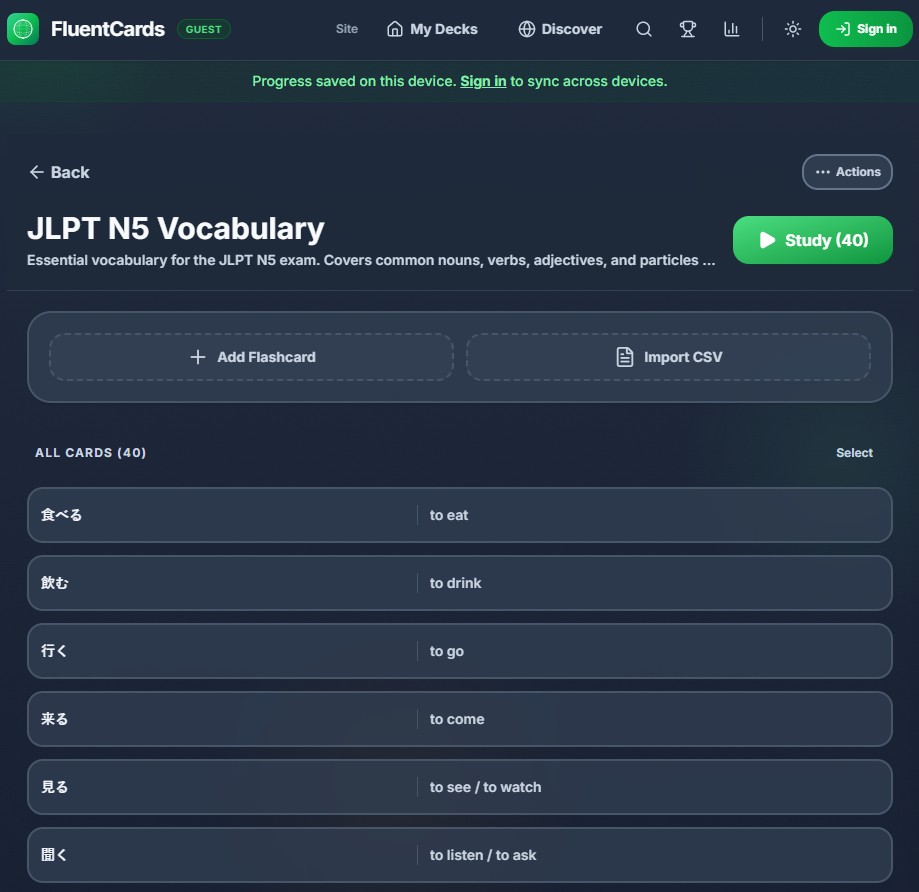
Name your deck and start adding flashcards. For Japanese, type kanji with furigana like 漢字[かんじ] and it renders automatically. Use auto-translate to generate card backs instantly.
Flip cards and rate your recall (Again / Hard / Good / Easy). The FSRS algorithm adapts to your memory and schedules the next review at the perfect time.
Watch your retention grow as the system learns what you need to practice. Review your stats and stay motivated.
Inspiring stories of famous learners and practical guides to improve your language learning.
Sor Juana Inés de la Cruz taught herself to read at age three, mastered Latin in 20 lessons, and amassed one of the largest private libraries in colonial Mexico. As a nun, she became the greatest writer of the Spanish Golden Age — all without formal education.
The testing effect is the most well-documented phenomenon in cognitive science. Learn why actively recalling information from memory beats every other study method — and how to harness retrieval practice for language learning.
TechniqueResearch shows that making errors is essential for language acquisition. Learn how corrective feedback, error analysis, and the science of mistakes can accelerate your fluency.
NeuroscienceDoes the brain have a 'deadline' for learning languages? Explore the science behind the critical period hypothesis, what it means for adult learners, and how to overcome age-related challenges in language acquisition.
Cognitive ScienceThe neuroscience of bilingualism reveals that learning a language reshapes your grey matter, enhances executive function, and delays dementia by 4-5 years.
NeuroscienceThe neuroscience of music and language reveals they share neural pathways. Learn how songs, rhythm, and melody can boost vocabulary retention by 60%.
PsychologyWhy your brain freezes when you try to speak a foreign language — and how neuroscience-backed strategies can help you overcome it.
BlogThe scientifically validated technique used by UN interpreters to build natural pronunciation and listening comprehension.
StoriesHe didn't speak a word of English until he was 21. He went on to become one of the greatest English novelists of all time.
StoriesHow a school dropout taught himself to write at a world-class level through deliberate practice and repetition.
StoriesHow a chemist with no language talent learned 16 languages through massive reading and context.
Join learners around the world. FluentCards is free to use with no ads.
Open FluentCards