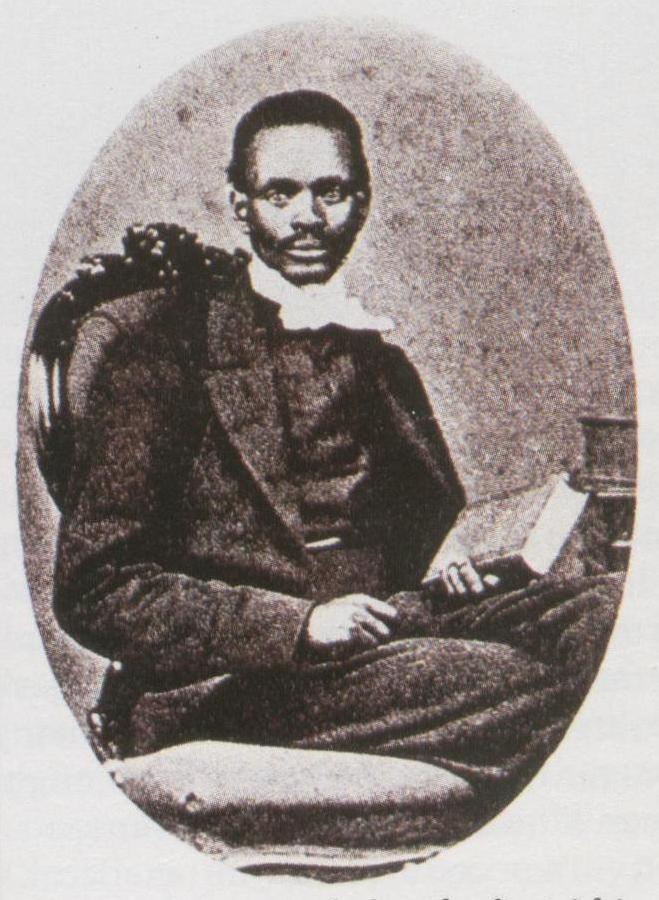
In December 1856, in a church in Glasgow, an old minister put one hand on the head of a twenty-seven-year-old Xhosa man and prayed over him for several minutes. The prayer, as a later biographer recorded it, began as a blessing and turned into something else: a tirade against British colonial policy, with the Colonial Secretary's name ringing around the building, delivered while the congregation sat and listened.
The man under that hand was Tiyo Soga. He had arrived in Scotland ten years earlier as a fifteen-year-old from the eastern frontier of the Cape Colony, unable to afford the fare and sent by a mother who did not know if she would see him again. He was about to become the first black South African ordained to the Christian ministry. And within fifteen years he would do something with language that no one from his side of the frontier had done before: he would take the literature of English Protestantism and rebuild it inside Xhosa, sentence by sentence, for readers who had never seen a book.
The Valley He Was Born Into
Tiyo Soga was born in 1829 in the Eastern Cape, in the country of the Ngqika Xhosa. His father, Jotello — remembered in the records as "Old Soga" — was one of the principal counsellors to Chief Ngqika and later to Sandile, a man of standing in the old order who was also, according to missionary accounts, the first Xhosa to use a plough and to irrigate his crops. He was a polygamist with a very large household: Tiyo is usually described as the seventh of thirty-nine children.
His mother was Nosuthu. Her decision is the hinge on which the whole story turns, and it was not a small one. When she became a Christian — through the teaching that had reached the Tyhume valley from the Glasgow Missionary Society, and through the influence of the Xhosa prophet and hymn writer Ntsikana — she sought and obtained release from her marriage on the grounds that she wanted her son raised as a Christian and given a formal education. She then took him to the Thyume mission station, where he attended the school of the Reverend John A. Chalmers.
That is worth pausing on. Nosuthu did not simply enrol a child. She gave up her position in a powerful household to make a specific educational choice, in a society where the school was attached to a mission that most of the political leadership regarded with suspicion. Every part of what follows was paid for by that decision.
The Board He Could Not Read
In 1844, at fifteen, Soga won a scholarship to Lovedale, the missionary institution the Glasgow Missionary Society had opened in 1841, about thirteen kilometres from Thyume. He arrived for the entrance examination and was shown a subtraction problem on the blackboard. He could not do it. He froze.
Chalmers intervened and persuaded the principal, the Reverend William Govan, to admit him anyway. It was a reasonable gamble. Within a term Soga was placing among the top three in almost every subject — a detail that tells you less about his brilliance than about the mismatch between what he had been taught at a mission school and what Lovedale assumed. What changed was not his ability. It was the density of the instruction.
The interruption came in 1846, when the War of the Axe broke out along the frontier and Lovedale closed. Soga and his mother took refuge at Fort Armstrong, and he kept studying at night by firelight. Govan then decided to return to Scotland and offered to take the boy with him and pay his way. Nosuthu agreed.
"My son belongs to God; wherever he goes God is with him... he is as much in God's care in Scotland as he is here with me." — Nosuthu, on letting her son leave for Scotland
Scotland, 1846 to 1849
Soga spent a year at a school in Inchinnan, in Renfrewshire, then moved to teacher training at the Free Church of Scotland Normal School in Glasgow. The John Street United Presbyterian Church effectively adopted him. A friend of Govan's, John Henderson, became his benefactor and funded the education that followed.
He was baptised in Glasgow on 7 May 1848. The sermon that day was preached, with what one imagines was deliberate symmetry, on the Ethiopian eunuch of Acts 8 — the African official who asks how he can understand what he is reading without someone to guide him.
He returned to the Cape in 1849 and worked for two years as a catechist, evangelist and interpreter at Thyume. Then came the episode that shows what he was made of. The Reverend Robert Niven asked him to help plant a new station, Uniondale, in the Amatole Mountains at Keiskammahoek. Because the mission was identified with the colonial authorities, it was burned to the ground by people who were at war with the colony. Soga was nearly killed. He refused to take the side of the chief leading that war, and he also refused a paid post as a government translator.
That refusal is the first clear statement of his position, and it is a linguistic one. He would not rent his bilingualism to the administration. A man with three languages and no money turned down the only job his languages made easy.
Latin with Ramsay, Greek with Lushington
In 1851 he went back to Scotland to prepare for ordination. He matriculated at the University of Glasgow — the first black South African student in its history — and studied Latin under William Ramsay and Greek under Edmund Law Lushington. He also trained at the Theological Hall of the United Presbyterian Church, first in Glasgow and then in Edinburgh, where his notebooks record lectures on Romans.
This is the part of the story that is usually compressed into the phrase "he was educated in Scotland", which hides the actual work. He learned Latin and Greek as an adult, in a second language, in a British university, in the 1850s, with no family precedent and no cohort of people who looked like him. Classics was the gatekeeping discipline of the nineteenth-century professional class, and he went through the gate on foot.
He was ordained in December 1856. The Paisley Herald and Renfrewshire Advertiser reported that he had "evinced powers of no ordinary description" and had "preached with remarkable receptance in some of the principal United Presbyterian pulpits in Glasgow". He married Janet Burnside, a Scotswoman, in early 1857. They would have eight children, one stillborn.
The Journal on the Water
On 13 April 1857 the Sogas left Scotland, travelling by train to London and then aboard the Lady of the Lake to Africa. On the voyage he began a journal, writing down what he saw and, more importantly, what he was leaving: fables, proverbs, legends, the genealogies of chiefs, folklore.
That journal is now regarded as the earliest known journal by a black South African. Its significance is easy to miss. He was not writing a travel diary. He was doing fieldwork on his own language and culture at the exact moment he was returning to it as a missionary, and he was doing it because he understood that the material was already under pressure. Within a generation, the political and educational structures of the Cape would be organised around the assumption that Xhosa oral tradition was the thing you replaced. He wrote it down instead.
Mgwali
The Sogas settled at Mgwali — Emgwali — among the Ngqika, and stayed for a decade, from 1857 to 1867. He built a station, a church and a school, preached in Xhosa, and taught. In July 1857, shortly after arriving, he wrote the hymn Lizalis' idinga lakho — "Fulfil Your Promise" — which became the best known of his compositions.
Its afterlife is extraordinary. The hymn was sung to open the first meeting of the South African Native National Congress in 1912, the organisation that became the African National Congress. It may also have shaped Nkosi Sikelel' iAfrika, the anthem of the movement and later of the country. A hymn written by a man with a Glasgow theology degree, in Xhosa, at a mission station on the eastern frontier, was still being sung at the founding of a national liberation movement fifty-five years later.
He also set to music Ntsikana's "Great Hymn", and his own "Bell Hymn", used to call worshippers to service, was based on Ntsikana's poetry. Ntsikana had died before Soga was born. The chain of influence ran from the first Xhosa Christian prophet, through the son of his followers, into the printed hymnal.
The Hardest Direction
Translation is where a language learner's knowledge is actually tested, and Soga translated in the direction that most learners avoid: out of the colonial language and into his own.
During a period of illness he translated the first part of John Bunyan's Pilgrim's Progress into Xhosa. It was published in 1867 as Uhambo lomhambi, and it has been called the most important literary influence in nineteenth-century South Africa after the Bible. His son John Henderson Soga later completed the work.
He was also on the advisory board set up to revise the Xhosa Bible, and he was openly critical of the first complete Xhosa Bible, produced by the Reverend J. W. Appleyard in 1859. He translated the greater part of the New Testament himself. That criticism is the mark of a real bilingual: he could hear where the Xhosa was wrong, and he was willing to say so about a text produced by a senior missionary.
Consider what translating Bunyan requires. It is not a phrasebook exercise. It means carrying allegory, dialogue, theology, narrative pacing and seventeenth-century English idiom into a language whose literary conventions were oral, whose audience had no experience of the source culture, and whose click consonants and concordial agreement system make word-for-word transfer impossible. Every sentence is a decision about what Xhosa can be made to do.
The Argument He Made in Print
Soga was a journalist as well as a minister. He contributed to Indaba, the first Xhosa newspaper, founded in 1862, writing on Xhosa proverbs, customs and legends.
In April 1865 he wrote a journal entry that became an article in the King William's Town Gazette, published on 11 May. It was a reply to his friend John Aitken Chalmers, who had argued in the same paper that the "Kaffir race" was indolent and degenerate and destined for extinction before the advance of white civilisation. Soga answered with the only authority his opponent would accept: scripture. Africa, he argued, had been given to Ham and his descendants, and nothing would dispossess them of it. Psalm 68:31 — "Ethiopia shall soon stretch out her hands to God" — was, he wrote, "the sheet-anchor of the Church of Christ".
Two things are true about this argument. It is a genuinely impressive piece of rhetoric: he beat a colonial intellectual on his own textual ground, in a newspaper, in English, using the Bible as a legal brief. And it is a product of its moment: the Hamitic framework he used had been invented by white supremacists to justify slavery, and he turned it around rather than rejecting it. He also used the word "Kaffir" of his own people throughout his life, as most people in his position did. The modern reader can hold both facts.
Tutura, and the End
In 1867 the Gcaleka chief Sarili asked Soga to start a mission among his people. He moved to Tutura, later called Somerville, in the Transkei, and built a church and a school there. The work was hard and his health was failing. He had suffered from poor health for years, and the move finished him.
He died on 12 August 1871, of tuberculosis, aged forty-two, in the arms of a fellow missionary, Richard Ross, with his mother Nosuthu beside him. He had been ordained for fifteen years.
The tributes were not local. The Glasgow Daily Herald republished a South African obituary describing him as "a man of high educational attainments... Modest and retiring in manner... An earnest, devoted pastor and missionary", and as "a man with few equals". There was an obituary in the newspaper of John O'Groats, at the northern tip of mainland Scotland. The memorial tablet in the Mgwali church, in Xhosa, calls him "An Ardent Patriot: A Large-Hearted Philanthropist... A Learned Scholar: An Eloquent Orator". In 2011 a monument was unveiled near his grave by former president Thabo Mbeki, before a crowd of more than two thousand.
The Letter to His Sons
He insisted that his children be educated in Scotland, and he sent his sons there with a letter of instructions that has become the most quoted thing he wrote.
"For your own sakes never appear ashamed that your father was a Kafir, and that you inherited some African blood... take your place in the world as coloured, not as White men, as Kafirs not as Englishmen."
He went on: "It is every whit as good and as pure as that which flows in the veins of my fairer brethren." And he told them to cherish the memory of their mother as "an upright, conscientious, thrifty, Christian Scots woman", and to be thankful for the connection to the white race that her marriage gave them.
The letter is contradictory, and the contradiction is the man. He wanted his sons to have every advantage Scotland could give and to refuse the identity that came with it. The four who survived to adulthood did unusual things with that instruction: Kirkland Allan Soga studied law at Glasgow and became the first black lawyer in South Africa, involved in the founding of the organisation that became the ANC. Jotello Festiri Soga became the first black veterinary surgeon in the country. John Henderson Soga became a minister and the first historian of the Xhosa nation. William Anderson Soga was ordained. Their sister Jessie Margaret Soga trained in Milan and at the Royal College of Music and became a contralto and a suffragist.
What the Method Teaches
Soga was not self-taught in the ordinary sense. He had Lovedale, Glasgow, Latin, Greek and a formal theological training, and pretending otherwise would erase the institutions that made him. But nothing about that education was handed to him. It was bought with his mother's marriage, a stranger's money, a principal's gamble on a boy who could not do a subtraction problem, and a decade of work in two languages at once. The lessons are unusually concrete.
- He learned the powerful language to argue with the powerful. Latin and Greek were not ornaments. They were the credentials that let him stand in a Scottish pulpit and the tools that let him read the texts his opponents quoted. Learn the register that opens the room you need to be in.
- He translated into his own language, not out of it. Most learners only ever translate inward, which keeps the second language as a code for the first. Producing Pilgrim's Progress in Xhosa forced him to find what Xhosa could do that English could not — and it made him an authority on his own language rather than a consumer of someone else's.
- He wrote down what could not be translated. Proverbs, fables, genealogies, legends. When a word has no equivalent, the equivalent is the context. Learners who collect collocations, idioms and set phrases are doing the same thing at a smaller scale.
- He studied in the gaps. By firelight at Fort Armstrong, during illness at Mgwali. The translation of Bunyan was the work of a sick man using the time he had.
- He kept both languages fully alive. He preached in Xhosa, wrote journalism in English, corresponded in both, and refused to let either become a costume. Being called a "Black Englishman" by other Africans and a "Kafir" by colonists is what happens to people who refuse both caricatures.
- He taught the next generation to inherit rather than to imitate. His children became the first black lawyer, the first black vet, and the first historian of the Xhosa. A language kept alive by one man became an institution within one generation.
Conclusion
Tiyo Soga learned to read in a valley where literacy was a missionary project, learned Latin and Greek in a Scottish university that had never enrolled a black South African, and then spent his short adult life putting English literature and scripture into Xhosa for people the empire had decided were finished.
He got the central thing right and compromised on more than a modern reader would like. He used the racial vocabulary of his time, worked within a theology built to justify his people's subjugation, and staked his argument on the one book his opponents could not dismiss. He died at forty-two of a disease that poverty and overwork made fatal, fifteen years into a career that had barely started.
And the hymn he wrote in July 1857, a few months after landing, was sung fifty-five years later at the founding meeting of the movement that would end apartheid. That is what a second language is actually for. Not for passing, and not for display, but for carrying what you know into a place it has never been, in a form that outlasts you.