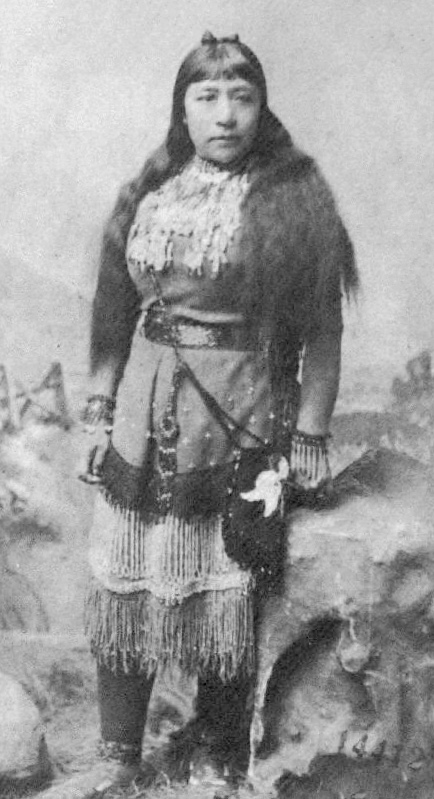
She was born with two names and spent her whole life being asked to choose between them. Her Northern Paiute name was Thocmentony, also written Tocmetone — Shell Flower. The name she used in public was Sarah, and later Sarah Winnemucca Hopkins, and the language she wrote her book in was not her first one. She learned it at thirteen, in a stranger's house, from a family who wanted a companion for their daughter.
Four decades later she had addressed audiences across the eastern United States, testified about government policy in Washington, and published a book that scholars still cite. She also watched the man who brought her into English die in a war against her own people, and buried her mother after a cavalry raid.
Her story is usually filed under tragedy or heroism. It is more useful read as a case study in what learning a language under pressure actually costs, and what it can be made to do.
Humboldt Lake, Around 1844: Thocmentony, "Shell Flower"
She was born "somewhere near 1844" at Humboldt Lake in what is now western Nevada, into a family that had already made a decision about the newcomers. Her father, Winnemucca — also recorded as Poito, a Shoshone who had joined the Paiute through marriage — was an influential war chief of a band of roughly 150 Northern Paiute people. The town of Winnemucca, Nevada is named after him. Her mother was Tuboitonie.
The decisive figure in her childhood was her grandfather. Tru-ki-zo, known to the Americans as Chief Truckee, had guided Captain John C. Frémont on his 1843–45 survey across the Great Basin, had fought in the Mexican–American War, and had built relationships with settlers and soldiers that he believed would protect his family. He was not naive. He was making a strategic bet on the value of being able to talk to the incoming power, and he pushed that bet through three generations.
Sarah spent her early childhood between eastern Oregon and western Nevada, learning to fish and gather plants. At six she travelled with her family to near Stockton, California, where the adults worked in the cattle trade.
1857: The Ormsby Household, and the Fastest English Lesson She Ever Had
The pivot came through her grandfather's connections. Around 1857 or 1858 — her own memoir places it in Genoa with "Major Ormsbey's family," and adds honestly "I am not sure" — William Ormsby, a hotel owner and civic leader of Carson City, Nevada, took Sarah and her sister Elma into his household. The stated purpose was companionship for his daughter Lizzie. The girls also did domestic work in the house. What they got in return was the thing that changed Sarah's life: hours of ordinary English, every day, from people who were paid nothing to teach them and treated them, at least in her telling, as children rather than as students.
While with them we learned the English language very fast, for they were very kind to us. — Sarah Winnemucca, Life Among the Piutes (1883)
Read that sentence twice, because it is a compressed theory of language acquisition from someone with no access to any theory. Two conditions did the work. The first is volume: the language was ambient, constant, and tied to real tasks — dishes, messages, meals — rather than to a lesson. The second, in her own words, is kindness. Nothing in the historical record suggests these were formal lessons. There were none. There was a household in which a thirteen-year-old had to understand and be understood every day, and in which the adults, for a while, were patient with her.
It worked fast enough to become permanent. She took the English name Sarah, stood out as one of the very few Paiute in Nevada who could read and write English, and later learned Spanish as well. By the time anybody needed a translator in her part of the world, there was a young woman available who had both languages inside her and no institutional certification whatsoever.
1860: The War That Killed the Man Who Taught Her English
Two years after that household, the arrangement ended. As silver discoveries drew migrants into the Washoe country, pressure on Paiute lands increased and Sarah's father arranged in 1859 to have his daughters returned to him.
In 1860 open conflict broke out. At Williams Station, two Paiute girls were kidnapped and abused and five men were killed. Settlers and miners organised a militia, and the man who led it, by default, was William Ormsby. He was killed by Paiute fighters in the first engagement of the Pyramid Lake War. The settlers were shocked by how well the Paiute fought; the militia was routed.
There is no clean way to write that passage. The man whose household taught Sarah Winnemucca English was killed by members of her own people, in a war that began with the abduction of two girls. Both facts are true, and anyone learning a second language while carrying a first-language identity should know that this is what the history of interpreters often looks like: the bridge is built on fault lines.
The "Paiute Royal Family": Four Years on Stage
The truce that followed lasted four years and was bitter. On the Pyramid Lake Reservation, promised government supplies did not arrive after the first year, and families with no training as farmers starved. Sarah's father begged for food from the military, and Camp McDermit eventually sent supplies.
Between roughly 1860 and 1865, her family travelled repeatedly away from the reservation and performed on stage — at Maguire's Opera House in Virginia City, Nevada, and in San Francisco — billed as "A Paiute Royal Family." They were paid, in effect, for being a spectacle.
For a language learner the arrangement is worth noticing anyway. Four years of public performance, staged in English-speaking towns, in front of people who paid to watch her family do something. Whatever else it was, it was thousands of hours of operating in the majority language, in a role where being understood mattered — and where she was the one explaining her family to an audience.
1865: Twenty-Nine of Thirty
What happened next is the reason the rest of her life was aimed at the government. Around 1865, while Sarah and her father were away in Dayton, Nevada, a Nevada Volunteer cavalry unit under Almond B. Wells attacked Old Winnemucca's camp at Winnemucca Lake. The band had been accused of cattle theft; the raid was indiscriminate.
Twenty-nine of the thirty people in the camp were killed — old men, women and children. Among them were Chief Winnemucca's two wives, including Sarah's mother, and an infant half-brother. Sarah's older sister Mary escaped the camp but died that winter from the conditions of the aftermath. Her younger sister Elma, who had been adopted by a French family in Marysville, California, was elsewhere, and survived.
She was about twenty-one. In the following years about 490 Paiute survivors gathered at Camp McDermit on the Nevada–Oregon border, seeking Army protection from the volunteer militia that had attacked them.
1871: The Interpreter's Job
At twenty-seven, in 1871, she was hired by the Bureau of Indian Affairs at Fort McDermitt as an interpreter. This is the point at which the childhood bet her grandfather had made was finally called in: the family had invested in English, and English was now the only currency the government accepted.
When the Malheur Reservation was established in eastern Oregon in 1872, she was invited by the agent, Samuel B. Parrish, to interpret there. By her account Parrish was effective — he encouraged the Paiute, ran a working agricultural programme, had a school built, and made her an assistant teacher. That is worth pausing on: the woman teaching in the reservation school had, herself, never attended a school in her life.
She married in 1872 — Edward Bartlett, a former Army first lieutenant, in Salt Lake City on 29 January. He abandoned her without money. She filed for divorce in 1876, returned to using Winnemucca, and described her self-support in the divorce record with three words that deserve their own paragraph:
I did sewing. I made gloves for a living. — Sarah Winnemucca, divorce decree, 1876
1878: Scout, Messenger and Translator in the Bannock War
Parrish was replaced in 1876 by William V. Rinehart, whose approach was the opposite of his predecessor's: he told the Paiute the reservation land belonged to the government, failed to pay workers for communal field labour, and alienated the leadership. In 1878 most of the Paiute and Bannock left the reservations, and the Bannock War began.
Winnemucca worked through it as a translator for General Oliver O. Howard of the U.S. Army, and also as a scout and messenger — riding between camps with information, in country where that was lethal work. She wrote that she and several other Paiute families were held hostage by the Bannock during the conflict. She was highly regarded by the officers she served, and included their letters of recommendation in her book five years later.
She also drew a conclusion from the war that would divide her own community: after working alongside Army officers she began to support military administration of the reservations over political appointees.
1879: Washington, and the Arithmetic of Being Heard
After the war, 543 Northern Paiute were moved to the Yakama Reservation in Washington Territory, where they endured severe deprivation — conditions her contemporaries and later historians have described as a concentration camp. Winnemucca travelled with them and worked there as a translator. Then she did something a translator is not supposed to be able to do.
She started lecturing across California and Nevada about the conditions her people were living in. In the winter of 1879–80 she went to Washington with her father and two other Winnemucca to lobby the executive branch and Congress for the internees' release. They obtained permission from the Secretary of the Interior, Carl Schurz, for the Paiute to return to Malheur at their own expense — and then watched the government "discontinue" the Malheur Reservation in 1879, closing it. Schurz revoked the permission. They came home with nothing.
Notice what language had become for her. In 1860 English was protection. In 1880 it was a tool for filing requests with an institution that answered in writing and mostly said no. Both uses depended on the same ability, acquired in a household in Genoa at thirteen.
1883: Writing a Book in a Language She Learned at Thirteen
In 1881 she married Lieutenant Lewis H. Hopkins, an employee of the Indian Department, and was hired by General Howard to teach Shoshone prisoners held at Vancouver Barracks. In 1883 the couple went east. Over that period Winnemucca delivered nearly 300 lectures in cities across the Northeast and Mid-Atlantic, aiming to make injustice against Native Americans visible and impossible to ignore. The press, less interested in policy than in spectacle, called her the "Paiute Princess."
In Boston she met the sisters Elizabeth Palmer Peabody and Mary Peabody Mann — the latter the widow of the education reformer Horace Mann. They promoted her speaking, then helped her turn her lecture material into a book. Life Among the Piutes: Their Wrongs and Claims was published in 1883: a memoir and a history of her people's first forty years of contact with European Americans, 268 pages, printed for the author and sold through Cupples, Upham & Co. in Boston and G.P. Putnam's Sons in New York. Mary Peabody Mann edited it.
It is considered the first known autobiography written by a Native American woman, and it carried the first U.S. copyright registration secured by a Native American woman. The anthropologist Omer Stewart called it "one of the first and one of the most enduring ethnohistorical books written by an American Indian."
And the editor's preface tells the truth about how hard it was to write, in a sentence that every second-language writer will recognise:
In fighting with her literary deficiencies she loses some of the fervid eloquence which her extraordinary colloquial command of the English language enables her to utter, but I am confident that no one would desire that her own original words should be altered. It is the first outbreak of the American Indian in human literature. — Mary Peabody Mann, Editor's Preface, 1883
The gap described there is a real, measurable thing in second-language development, and it is the opposite of the usual pattern. Most learners write better than they speak; the written language is the slow, checked, edited one, and speaking runs ahead of it only in mistakes. Winnemucca had the reverse profile. Her spoken English was extraordinary and her written English was the harder, slower channel, so she wrote out her most important points in advance rather than relying on improvisation, and "fought" with the page to get them down.
She did not wait for the writing to become easy. She published anyway — which is the decision most learners never make, because they are waiting for accuracy to arrive before they produce anything.
One of the book's sharpest passages concerns education directly, and it came from her months observing an agency that had been running for eighteen years:
In eighteen years could he not have taught them some English? ... I never heard an Indian man or woman speak the English language except the three interpreters and some half-breeds. — Sarah Winnemucca, Life Among the Piutes (1883)
Her argument was not abstract. She had learned English in a household, in a couple of years, without a curriculum. She was looking at an institution that had had eighteen years and a captive population and had produced almost no speakers, and she was asking what the teaching was actually for. The answer she had already worked out: language instruction that is not connected to daily, urgent use is not instruction. It is a notation system.
1885: The School at Lovelock
She came home and built the thing she had been arguing for. After a return to Nevada in 1884 and a year lecturing in San Francisco, she and her brother Natchez founded a private school for Native children at Lovelock, Nevada — the Peabody Indian School, named for her Boston benefactor Mary Peabody Mann. Its purpose was explicitly bilingual: to teach Paiute children in order to promote Paiute culture and language, alongside English.
It ran for about two years. It closed in 1887, and the children were transferred to a facility in Grand Junction, Colorado, as federal policy shifted after the perceived success of the Carlisle Indian School towards English-only boarding schools. In the same year, the Dawes Severalty Act began allotting communal reservation land to individual households in order to force assimilation. Her husband died of tuberculosis on 18 October 1887; despite a bequest from Mary Peabody Mann and attempts to convert the school into a technical training centre, Winnemucca was in financial difficulty by the time he died. In 1885 she had told the Daily Silver State that she had fought "for the general good of [her] race, but as recent events have shown that they are not disposed to stand by me in the fight, I shall relinquish it."
She spent her last four years in retirement from public life and died of tuberculosis on 17 October 1891, at her sister Elma's home at Henry's Lake, Idaho, aged about forty-seven.
The Reckoning: What Her Own People and History Made of Her
Honest accounts of Winnemucca have to hold two verdicts at once.
She was criticised in her lifetime and afterwards for a tendency to exaggerate her standing among the Paiute when addressing white audiences — the "princess" framing was partly a press invention and partly a role she adopted because it worked on the lecture circuit. Within her own community, her assistance to the U.S. military during a period of war against the Paiute was divisive, as was her advocacy of assimilation to Anglo-American ways.
The recognition came late and came anyway. In 1993 she was inducted into the Nevada Writers Hall of Fame. In 1994 she entered the National Women's Hall of Fame, and an elementary school in Washoe County, Nevada was named for her. In 2005 the state of Nevada gave a statue of her, by the sculptor Benjamin Victor, to the National Statuary Hall Collection in the U.S. Capitol — where she stands as one of two figures representing a state whose government once hunted her family.
What Sarah Winnemucca's Method Teaches a Language Learner
Strip away the century and the context and there are five lessons in her life that apply to anybody learning a language now.
- Volume inside a real relationship beats curriculum. She learned English because she lived in an English-speaking household where she had daily work and daily affection. The two ingredients were constant use and willing interlocutors. Neither requires money; both require people.
- Speaking and writing can develop at very different speeds — and you should publish anyway. Her spoken English outran her written English permanently. She wrote the book by preparing her key points in advance. That is a strategy, not a failure: pre-script what matters most, then write in public before it is perfect.
- Translate for a reason bigger than practice. Every era of her life used English instrumentally: to plead for food, to file complaints, to address Congress, to teach children. The language was never the goal. That is why it stuck.
- Being the bridge is not a neutral job. She mediated between her people and a government at war with them, and both sides held it against her at times. Learners who become the fluent one in a family or a community should know they are taking on a role with weight, not just a skill.
- When the institution fails, teach in the language you were denied. Her response to an agency that produced almost no English speakers in eighteen years was to open a school that taught Paiute children bilingually — in both languages, deliberately. Twenty-two centuries of language policy are still arguing about that, and she had made her choice in 1885.
Thocmentony is remembered as the first Native American woman to publish a book in English. The more useful way to remember her, if you are learning a language, is as the proof that the fastest route into a new language is being thrown into a household, a job or a cause that does not care whether you are ready — and that the writing can come second, from the mouth, if you refuse to wait.