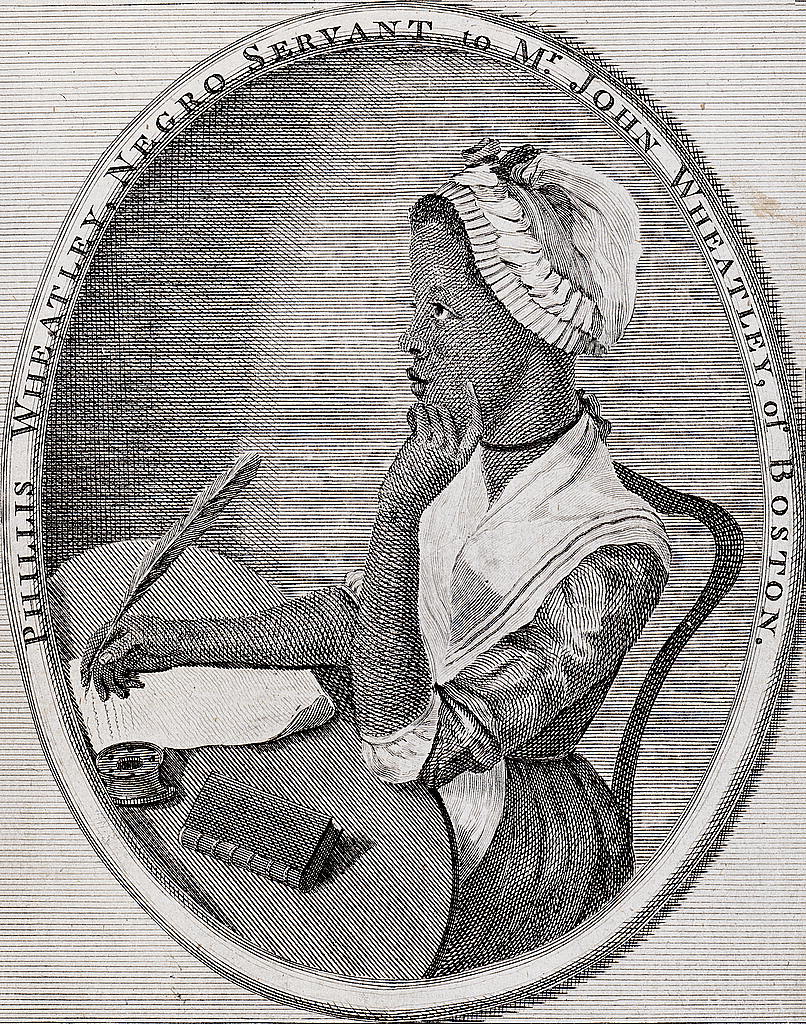
Phillis Wheatley, frontispiece to Poems on Various Subjects, Religious and Moral (London, 1773), engraved by Scipio Moorhead, an enslaved African American artist in Boston. Wheatley wrote a poem to him in the same volume. (Wikimedia Commons, public domain)
On 11 July 1761 a slave ship called the Phillis came into Boston with cargo that included a child of seven or eight, frail and sickly, wearing nothing but a piece of soiled carpet. She had been taken from West Africa, probably from the Senegambia region, and sold. She had no English. She had no idea what anything around her was called.
The man who bought her was John Wheatley, a Boston merchant and tailor, who was looking for a companion for his wife Susanna. The child was given the name of the ship. She was set to work in the household, and within a few years she would be reading the Latin classics, publishing poetry on two continents, and sitting in a room with eighteen of the most powerful men in Massachusetts while they decided whether to sign their names to a statement that she had written her own poems.
What makes her one of the most useful language-learning stories on record is not the poetry, remarkable as it is. It is that her progress was documented by witnesses, in a primary source written by the man who owned her, and that the documentation survives.
The Sixteen Months
The evidence comes from a letter John Wheatley sent to the London bookseller Archibald Bell on 14 November 1772, and which was printed inside her book. It is one of the most extraordinary sentences about language acquisition written in the eighteenth century:
"Phillis was brought from Africa to America, in the Year 1761, between Seven and Eight Years of Age. Without any Assistance from School Education, and by only what she was taught in the Family, she, in sixteen Months Time from her Arrival, attained the English Language, to which she was an utter Stranger before, to such a Degree, as to read any, the most difficult Parts of the Sacred Writings, to the great Astonishment of all who heard her. As to her Writing, her own Curiosity led her to it." — John Wheatley, letter to Archibald Bell, Boston, November 14, 1772
Three things in that passage are worth pulling apart slowly, because each one is a study method.
"Without any Assistance from School Education." No classroom, no textbook, no timetable. Her entire syllabus was a household.
"By only what she was taught in the Family." The instruction was personal and continuous. Susanna Wheatley's daughter Mary, roughly eighteen when Phillis arrived, took on her education, and the family's son Nathaniel helped. Think about what that arrangement produces: a beginner with two dedicated tutors who are available all day, every day, in the actual language, correcting in real time. It is the most efficient language-learning configuration that has ever existed, and it is what almost no adult learner has.
"To read any, the most difficult Parts of the Sacred Writings." The target text was the hardest thing in the house. This is the part that gets lost when the story is told as a prodigy anecdote. She was not working through graded vocabulary lists. She was reading Scripture — dense, archaic, syntactically complex — and being read to from it, in a family for whom it was the central text. What she got was not a simplified input stream but a demanding, meaningful one, saturated daily, in a single domain she cared about.
Sixteen months from zero to fluent reading of difficult prose. It is worth saying what that number does not mean. It is not evidence that languages take sixteen months, and her conditions are not replicable by an app. It is evidence of what saturation with meaningful text plus a household that talks to you can do — and, given the dates, it is one of the fastest documented results of its kind in the historical record.
What the Household Actually Contained
The Wheatley home was not a school, but it was a reading environment of a kind that most colonial Bostonians, including many free white children, never had access to. It held English literature, a Bible, and eventually the Latin and Greek classics — and Phillis went through all of it.
By the age of twelve she was reading the Latin and Greek classics in the original languages and working through difficult passages of the Bible. She was particularly devoted to Alexander Pope, the great neoclassical poet and translator, and through Pope's translation of Homer she developed a taste for Greek myth and epic. Pope's style — rhyming couplets, inverted word order, balanced clauses — is all over her own verse. She had learned a craft by taking a model apart and rebuilding it.
Her first published poem appeared just after her fourteenth birthday. "On Messrs. Hussey and Coffin," a poem about two sailors who narrowly survived a shipwreck, ran in the Newport Mercury on 21 December 1767 — the first known publication of a poem by a Black woman in America. It had been submitted by Susanna Wheatley.
There is one more detail about her learning that circulates widely, and it needs a label. In 1834, fifty years after her death, a writer named Margaretta Matilda Odell published a memoir that claimed Phillis had been "frequently seen endeavouring to make letters upon the wall with a piece of chalk or charcoal." Odell's account is the source of much of the Wheatley legend, including the image of the child practising letters on a wall. It may well be true. It should also be handled with care: the poet Honorée Fanonne Jeffers's 2020 collection The Age of Phillis argues explicitly that Odell rendered Wheatley as a figure in a sentimental novel rather than a real person, and modern scholarship leans on the primary documents — John Wheatley's letter, her own poems, the attestation — rather than the memoir. The chalk on the wall is tradition, not record. What is on record is the letter's phrase "her own Curiosity led her to it," which says something similar without the decoration: the writing came from her, not from a lesson plan.
The Poem That Travelled
In 1770 the evangelical preacher George Whitefield died, and Wheatley wrote an elegy for him. Whitefield was one of the most famous men in the English-speaking world, and the poem was printed as a broadside and reprinted repeatedly on both sides of the Atlantic. It brought her a transatlantic readership and, more usefully, patrons — including Selina Hastings, the Countess of Huntingdon, who had known Whitefield and who would become the route to a publisher.
The elegy is the point at which her writing stopped being a household curiosity and became an asset with a market. That shift matters for any learner: she had produced something other people wanted, in a form they could pass around. Her reputation was not bestowed on her after the fact. She built it with a piece of output aimed at a real audience at a real moment.
The Book Nobody Would Print
By 1772 she had accumulated twenty-eight poems. Susanna Wheatley advertised in Boston newspapers for subscribers — three hundred were needed to fund a volume — and the project failed. Not because the poems were bad, but because most readers could not believe a teenage enslaved girl had written them. American publishers would not touch it. The intellectual climate of the moment is captured by what the leading European philosophers had written: David Hume's suspicion that Black Africans were "naturally inferior to the whites," Kant's remark that they had "by no means any feeling that rises above the trifling." A book of neoclassical verse by an enslaved African was, to that audience, an impossibility.
So the manuscript went to London. The Countess of Huntingdon directed Wheatley to Archibald Bell, a bookseller in Aldgate, and Bell — who would have to sell the thing — asked for something a modern publisher would recognise instantly as a liability problem. Since Phillis was a slave, he replied, he would need proof that she had written the poems herself.
What followed is the part of the story that no language learner should skip. On 8 October 1772, eighteen of Boston's most respectable men signed an attestation clause that was printed at the front of the book. Among the eighteen were Governor Thomas Hutchinson, Lieutenant Governor Andrew Oliver, John Hancock — later famous for the signature on the Declaration of Independence — James Bowdoin, the poet Joseph Green, and the Reverend Samuel Mather, son of Cotton Mather. Their signed statement reads:
"WE whose Names are under-written, do assure the World, that the POEMS specified in the following Page, were (as we verily believe) written by Phillis, a young Negro Girl, who was but a few Years since, brought an uncultivated Barbarian from Africa, and has ever since been, and now is, under the Disadvantage of serving as a Slave in a Family in this Town. She has been examined by some of the best Judges, and is thought qualified to write them." — Attestation printed in Poems on Various Subjects, Religious and Moral, London, 1773
Popular retellings describe a formal interrogation in a Boston hall, with eighteen magistrates and ministers examining her for hours. It is a good scene, and it is not documented. The phrase "she has been examined by some of the best Judges" may have been generic assurance for readers outside Boston; Henry Louis Gates Jr., who thought hard about this clause, noted that there is no surviving record of a public examination. Either way, the attestation is real, the signatures are real, and the meaning is unmistakable: her literacy was put to a vote by the most powerful men in the colony, and she passed.
Sit with that for a second. Most learners are never asked to prove their language ability anywhere except a test. She had to prove hers to a panel that included a colonial governor and a signer of the Declaration of Independence, before her work could be printed at all.
London, 1773
In the spring of 1773, aged about twenty, she sailed for London with Nathaniel Wheatley — partly, reportedly, because her health needed sea air. She was there roughly six weeks, and she was received as a celebrity.
She stayed in the household orbit of the Countess of Huntingdon, to whom the book was dedicated. She met Granville Sharp, the abolitionist who had recently secured the Somerset ruling that slavery had no basis in English law — the same Granville Sharp who gave her a tour of the Tower of London. She met Benjamin Franklin, who was in London representing colonial interests, and she thought highly enough of him that she planned to dedicate her next book to him. The Earl of Dartmouth gave her five guineas to buy the collected works of Alexander Pope, and the incoming Lord Mayor, Brook Watson, gave her a folio edition of Milton's Paradise Lost — the two poets most visible in her own verse.
Poems on Various Subjects, Religious and Moral was published in London on 1 September 1773, with the attestation and John Wheatley's letter printed in the front matter and a portrait of the author engraved by Scipio Moorhead — an enslaved Boston artist to whom Wheatley addressed a poem in the same volume. Copies crossed the Atlantic aboard the Dartmouth, one of the ships seized in the Boston Tea Party that December. The protesters threw the tea overboard and left the books.
Freedom, and the Letter About It
Wheatley returned to Boston when Susanna Wheatley fell ill. She was freed within weeks of her return — some accounts give October 1773 — and continued to live with the family until John Wheatley's death in 1778. Susanna died in March 1774.
That year, Wheatley wrote to the Reverend Samson Occom, a Mohegan Presbyterian minister and poet with whom she had corresponded since childhood, after Occom publicly attacked Christian ministers who kept people enslaved. Her letter was printed in the Connecticut Gazette on 11 March 1774:
"I do not say they would have been contented without it, by no means, for in every human Breast, God has implanted a Principle, which we call Love of Freedom; it is impatient of Oppression, and pants for Deliverance; and by the Leave of our modern Egyptians I will assert, that the same Principle lives in us." — Phillis Wheatley to the Rev. Samson Occom, printed in the Connecticut Gazette, March 11, 1774
A woman who had been in the American colonies for thirteen years, who had arrived speaking no English, was now writing public political prose that called slaveholders "our modern Egyptians" and quoted her own chosen scripture against them.
Washington, and the Second Book That Never Appeared
On 26 October 1775 she sent a poem praising George Washington to Washington himself. Washington, in the middle of planning the fortifications at Dorchester Heights, wrote back on 28 February 1776:
"I thank you most sincerely for your polite notice of me, in the elegant Lines you enclosed; and however undeserving I may be of such encomium and panegyrick, the style and manner exhibit a striking proof of your great poetical Talents. … If you should ever come to Cambridge, or near Head Quarters, I shall be happy to see a person so favourd by the Muses, and to whom nature has been so liberal and beneficent in her dispensations." — George Washington to Phillis Wheatley, February 28, 1776
The poem was reprinted in the Virginia Gazette and in Thomas Paine's Pennsylvania Magazine; Wheatley visited Washington at Cambridge in March 1776. Washington's reputation made her work more widely read than anything she had published before or would publish again.
And then the story turns. She married John Peters, a free Black man, in 1778, and the last six years of her life were poverty. She advertised proposals for a second volume in 1779 and again in 1784 — a book that was to gather thirty-three poems and thirteen letters and be dedicated to Benjamin Franklin. It was never published. Her husband was jailed for debt, she took work as a scullery maid in a boarding house, and of her three children none survived early childhood. She died on 5 December 1784, aged thirty-one, in a Boston boarding house; her last surviving infant died around the same time, and they were buried together in an unmarked grave. The manuscript of the second book was sold or lost, and it has never been found.
She was not a curiosity everyone politely applauded. She was an argument — living proof that the racial hierarchy of her century was false — and she paid for it. In the 1950s and 1960s, critics dismissed her as an assimilationist; the reassessment that followed, and the scholarship of Henry Louis Gates Jr. and of Vincent Carretta, has restored the more interesting truth: a woman who used the only language of power available to her, learned it faster than almost anyone on record, and turned it against the people who owned her. In 1993 she was chosen for the Boston Women's Memorial on Commonwealth Avenue, alongside Abigail Adams and Lucy Stone.
What a Learner Can Take From Her
- Sixteen months is a documented number, and the conditions explain it. Total immersion, two personal tutors, a single high-stakes text read aloud daily, and constant feedback. You cannot replicate all of that, but you can replicate the shape of it: one domain, real text, high frequency, immediate correction.
- Read above your level and let the text be hard. Her syllabus was the most difficult prose in the house. Simplified material is useful at the beginning, but the thing that built her range was reading something that mattered to the people around her at full complexity.
- Imitation is a technique, not a cheat. Her couplets are Pope's; her epic imagery is Milton's and Homer's. She learned the craft by taking models she admired apart and writing inside their forms. Copying a writer's sentence structure deliberately is one of the oldest working methods in literary history.
- Translation is a route into a dead language. She rendered Ovid into English verse — the "Niobe in Distress" of Metamorphoses VI — and the family's own testimony names Latin as something she was learning herself. Translating what you can already feel your way through is how you learn to read a classical language without a class.
- Produce output for a real audience, early. A broadside elegy for a famous preacher, at seventeen, made her name and created the demand for a book. Output that other people can read — a published post, a recording, a letter someone actually answers — does things that exercises cannot.
- Expect to be asked for proof, and keep the receipts. Whatever you are learning, there will be a moment when somebody doubts you — a placement test, an interviewer, a colleague who assumes the accent means the competence is not there. Wheatley's answer was to keep the artefacts: the signed attestation, the printed poem, the letter from Washington. Track your progress in files someone else can read, and you will never have to argue from memory.
- The ending does not cancel the learning. Wheatley died at thirty-one in poverty, with her second book lost, and the work she did in sixteen months as a child is still read two hundred and sixty years later and still taught in universities. Progress in a language is not a promise about how the rest of your life will go. It is a capability, and it stays in the record.
What she left behind, for a learner, is not really the poetry. It is the shape of a method — one household, one book, one audience, one demand for daily correction — and a demonstration of how much ground it can cover in a year and a bit. The rest is the reminder that the powers that doubted her needed eighteen signatures and a printed clause to say out loud what her poems had already proved.