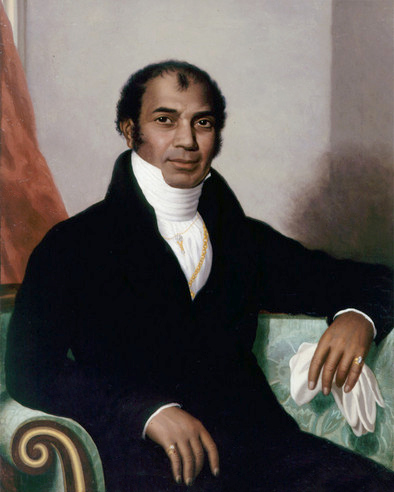
Sake Dean Mahomed (c. 1759–1851), Indian traveler, author, restaurateur and "shampooing surgeon" to two British kings. (Wikimedia Commons, public domain)
On 15 January 1794, a printing shop in Cork put a book on sale whose title page was unlike anything the city had seen. It read: The Travels of Dean Mahomet, A Native of Patna in Bengal, Through Several Parts of India, While in the Service of the Honourable the East India Company, In a Series of Letters to a Friend. The author signed the dedication from Cork's South Mall, and listed his rank on the page above the text as an identity rather than a complaint: an East Indian.
The man behind it had arrived in Ireland ten years earlier, aged about twenty-five, as a servant-companion of the British officer who had taken him in as a boy in Patna after his father was killed in battle. He had learned his English on the way — partly in the army, partly in a schoolroom in Cork that he entered as an adult, on purpose, because he knew his English was not good enough for a book.
That decision is the reason we know his name. He went on to open the first Indian restaurant in England, to bring Indian therapeutic massage to Europe, to be appointed "shampooing surgeon" to George IV and William IV, and to write three more books in a language he had learned as a grown man. He is now widely described — and argued in detail by the historian Michael H. Fisher — as the first Indian author in English.
A Boy from Patna Whose Father Did Not Come Home
Dean Mahomed was born around May 1759 in Patna, then part of the Bengal Subah of the Mughal Empire and today the capital of the Indian state of Bihar. His own books give 1749, a discrepancy historians treat as a slip; the name on his title pages is spelled in half a dozen ways across his life, a reminder that transliteration was a personal improvisation in the eighteenth century. He later adopted the honorific Sake, from Sheikh, and histories have kept it attached to him ever since.
His father served in the Bengal Army, a force that recruited heavily from Bihar. Historian Michael Fisher believes he was recruited by Robert Clive during a drive in the town of Buxar. When Mahomed was about eleven, his father was killed in battle. The boy's remaining route upward ran through the army, and it opened because of a person rather than a plan: Captain Godfrey Evan Baker, an Anglo-Irish Protestant officer, took him under his wing.
Mahomed served in the East India Company's army as a trainee surgeon and saw action against the Marathas. He stayed with Baker until 1782, when the captain resigned his commission. Mahomed resigned too — not because he had another post waiting, but to follow the man he called his best friend to the other side of the world.
Cork, and a Schoolroom at Twenty-Five
In 1784 he emigrated to Cork in Ireland with the Baker family. He was a Muslim Indian in a Protestant Irish city, without a profession, without family, and without a claim on anyone's protection except the goodwill of the household he had traveled with.
His response is the part of this story that should interest anyone learning a language right now. He enrolled in a local school to improve his English.
Think about what that took. He was not a child placed in a classroom by parents. He was a grown man with a decade of military service behind him, sitting among schoolboys to be corrected on his grammar, in a country where his accent and appearance made him permanently conspicuous. He did it anyway, and the timing tells us he understood the actual problem: he already spoke English well enough to be understood. He needed to write it well enough to be published.
Cork also gave him his wife. He fell in love with Jane Daly, described in the records as "a pretty Irish girl of respectable parentage." Her family opposed the match, because at the time it was illegal for Protestants to marry non-Protestants in Ireland. The couple eloped to another town and were married in the Diocese of Cork and Ross. In 1786 Mahomed converted to Christianity.
Turning Ten Years of Listening into 38 Letters
The book he published on 15 January 1794 was an epistolary travel narrative — 38 letters to a friend — a form as ordinary for novels and travel writing of the era as a blog series is now. It covers the years 1770 to 1775, when he moved with the Bengal army through northeastern India as a camp follower, and it ends with his voyage to Britain and his landing at Dartmouth in September 1784.
His subject was the country he had left. He describes Calcutta, Varanasi, military campaigns, trade, food, wildlife, and customs, and he does it as a man standing between two audiences. The opening pages set the two worlds against each other:
"The face of every thing about me [is] so contrasted to those striking scenes in India." — Dean Mahomet, The Travels of Dean Mahomet (Cork, 1794)
Then there is the mechanics of getting a book out of a foreign author in 1794, which are worth knowing because they show what he had to build. There was no literary agent and no publisher's advance. There was a subscription list: wealthy readers promised to buy copies in advance, and their names were printed at the front, partly as an honor and partly as proof that the buyer was respectable.
Mahomed's subscribers fill fifteen pages of the volume. They include the Viscountess Doneraile, the Right Reverend Doctor Coppinger, Bishop of Cloyne, the High Sheriff Kilner Brazier, the Ursuline Convent, Cork lawyers, army officers, and — a detail Irish readers enjoy — Thomas Addis Emmet, later a leader of the United Irishmen. The largest single order came from the Baker family, who took a hundred sets, and his own printer, Mr. J. Connor, took twenty.
He dedicated the book to William A. Bailie, Esq., a colonel in the service of the East India Company, and told him plainly what a patron's name was for. His argument, in the ornate register he had mastered from printed models, was that a distinguished man's patronage is a powerful inducement, and that the colonel's condescension in letting him attach his name to the work claimed Mahomed's best acknowledgments. Every phrase is doing the work of a cover letter, in the writer's third language.
Two honest caveats belong here. The literary scholar Mona Narain observes that Mahomed tells India's story from an essentially European perspective — he consistently writes "we" when he means himself and the Europeans, and his book does not criticize the Company's administration. And Fisher notes that some passages closely paraphrase earlier travel narratives, which was normal practice then and is a reminder that a self-taught writer assembles his voice from what he can find. Neither point diminishes the achievement. Both show how he had learned the conventions of a genre that did not belong to him.
The Restaurant, and Then the Baths
Inevitably, the book did not pay for a life. What Mahomed did next shows a man fluent in the language of commerce as well as prose.
At the turn of the century he moved to London's Little Ryder Street. He worked for the nabob Basil Cochrane, who had installed a public steam bath in his Portman Square house and promoted its medical benefits, and Mahomed may have been the person who introduced champi — shampooing, or Indian therapeutic massage — there.
In 1810 he opened the Hindoostane Coffee House in George Street, near Portman Square: the first Indian restaurant in England. His advertising offered hookah "with real chilm tobacco, and Indian dishes, ... allowed by the greatest epicures to be unequalled to any curries ever made in England," and the establishment ran a home delivery service — a takeaway, two centuries early. The venture failed in 1812 on money, as restaurants often do.
In 1814 the family moved to Brighton and opened Mahomed's Baths, the first commercial "shampooing" vapor masseur bath in England, on the seafront site now occupied by the Queen's Hotel. The treatment was advertised in the local press in terms that sound like a modern service page:
"The Indian Medicated Vapour Bath, a cure to many diseases and giving full relief when every thing fails; particularly Rheumatic and paralytic, gout, stiff joints, old sprains, lame legs, aches and pains in the joints." — Sake Dean Mahomed's advertisement, quoted in his Shampooing (Brighton, 1826)
The business worked. Hospitals referred patients to him, he became known as "Dr. Brighton," and he was appointed shampooing surgeon to both George IV and William IV. Jane was not a bystander in this: advertisements said she too possessed "the art of shampooing" and that she superintended the Ladies' Baths. Capital was always tight, though, and in the late 1830s the baths went to auction and the family moved into more modest Brighton lodgings.
Writing as Marketing: Three More Books in English
What kept the enterprise visible was print, and this is where his second career as an English author happened. In 1820 he published Cases Cured by Sake Deen Mahomed, Shampooing Surgeon, and Inventor of the Indian Medicated Vapour and Sea-Water Bath — case histories, the oldest marketing genre in medicine. Then came Shampooing; or, benefits resulting from the use of the Indian medicated vapour bath, which went through three editions (1822, 1826, 1838) and was dedicated to George IV.
In it he wrote about resistance, and about being disbelieved in a new country — a passage that any adult learner will recognize in a different key:
"It is not in the power of any individual to give unqualified satisfaction, or to attempt to establish a new opinion without the risk of incurring the ridicule, as well as censure, of some portion of mankind. So it was with me: in the face of indisputable evidence, I had to struggle with doubts and objections raised and circulated against my Bath, which, but for the repeated and numerous cures effected by it, would long since have shared the common fate of most innovations in science." — Sake Dean Mahomed, Shampooing (1822; 2nd ed. 1826)
He also used the book to introduce himself, in the third-person modesty of the period — and here his own account of his early life differs from the historians', including in that birth year of 1749:
"The humble author of these sheets, is a native of India... I was educated to the profession of, and served in the Company's Service, as a Surgeon, which capacity I afterwards relinquished, and acted in a military character, exclusively for nearly fifteen years." — Sake Dean Mahomed, Shampooing
Death, and Fifty Years of Being Forgotten
Dean Mahomed died on 24 February 1851 at 32 Grand Parade, Brighton, aged about ninety-two, and was buried at St Nicholas' Church, where his son Frederick was later laid beside him. Frederick ran a Brighton gymnasium teaching fencing and gymnastics. A grandson, Frederick Henry Horatio Akbar Mahomed, became an internationally known physician at Guy's Hospital who made important contributions to the study of high blood pressure — the family kept climbing for a hundred years. Another generation, fighting in the First World War, changed their surnames to Deane and Wyatt to avoid the xenophobia of the period.
Mahomed himself, once famous enough to be a fixture of Brighton society, faded. He stayed faded for a century. The poet and scholar Alamgir Hashmi drew attention back to him in the 1970s and 1980s, Rozina Visram's Ayahs, Lascars and Princes brought him to a wider public in 1998, and Fisher's 1996 study The First Indian Author in English settled his place in literary history. The City of Westminster unveiled a green plaque in 2005 at 102 George Street, near the restaurant he had opened nearly two centuries before. On 15 January 2019, the anniversary of his book's publication, Google marked him with a doodle on its home page.
What a Learner Can Take from Dean Mahomed
His story is not a fable about talent. It is a fairly plain account of a man who worked out what he lacked, found the institution that could fix it, and then used the language for something he wanted.
- Adult learners can enroll. He was about twenty-five when he went back to school in Cork, in a second language, as a visible outsider. The classroom is not only for children; it is for anyone whose self-taught version has hit its ceiling.
- Ask what the language is for. He spoke English well before he could write it to a publisher's standard. Naming the specific gap — writing, not speaking — is what turned a vague wish into a course of study.
- Build a structure that sustains you. A subscriber list is an odd thing to copy, but its function is recognizable: fifteen pages of people who had committed in advance to his book. Find the modern equivalents — a class with a fixed hour, a tutor you pay monthly, study partners who expect you.
- Use the language to sell something real. His fluency mattered to him because his bathhouse and his restaurant needed customers. Purpose is the most reliable long-term motivator there is, and it does not have to be literary.
- Do not wait for perfect grammar. His prose is ornate and occasionally imprecise; the birth date he printed was wrong. What survived was not flawless English. It was a specific, vivid account of a life, written by someone who had the nerve to publish in a language he had learned as an adult.
The most useful lesson may be the least romantic one. He learned English well enough to be published, then kept writing for forty years — case notes, advertisements, medical claims, dedications to kings — until writing in English had stopped being an event and become a habit. That is what fluency finally looks like: not a moment of mastery, but a language you no longer have to think about using.