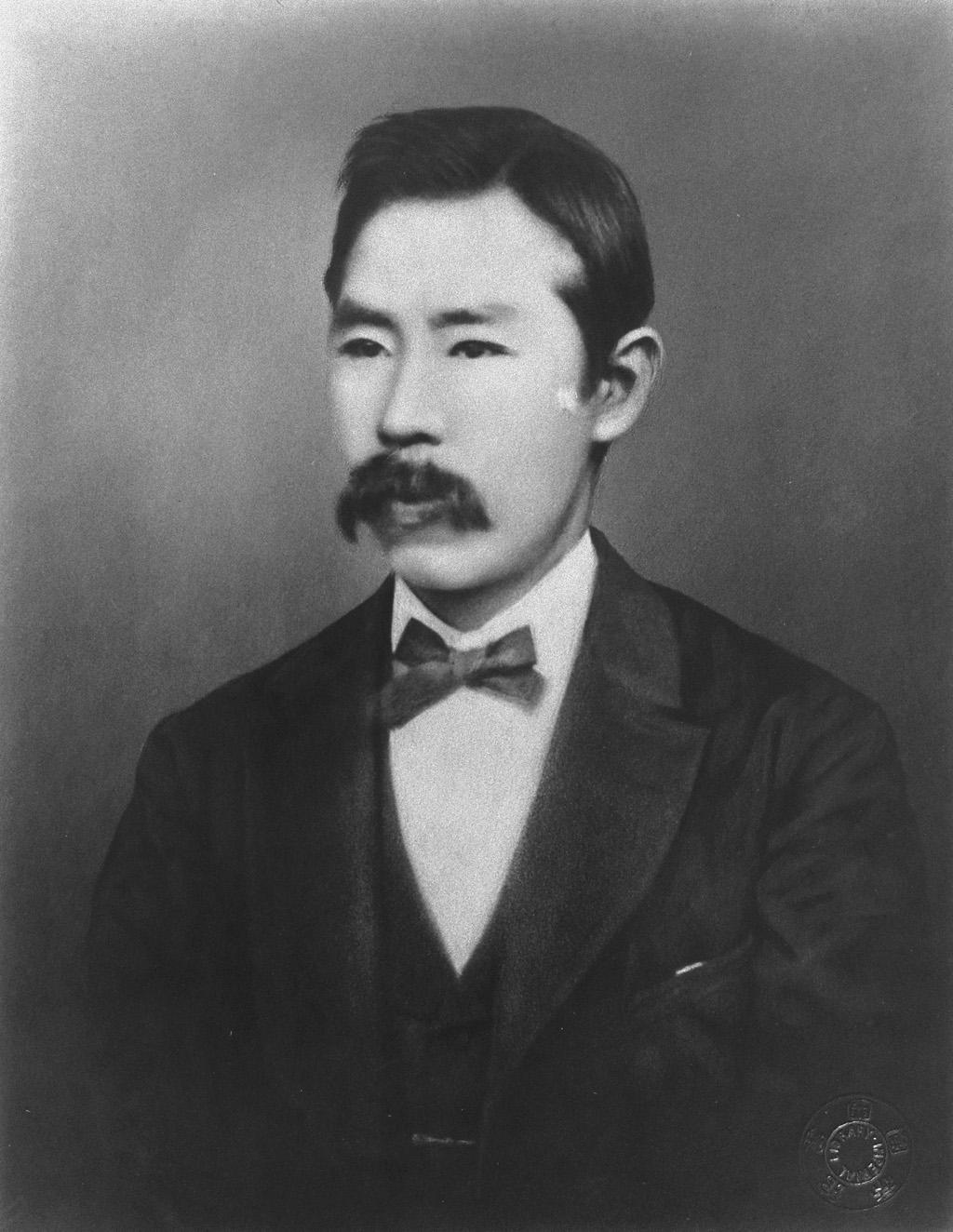
In the spring of 1864, a twenty-one-year-old Japanese man walked down to the foreign concession at Hakodate in the dark and stepped onto an American ship. He had arranged the boarding in secret: the captain had agreed to take him only on the condition that he come aboard at night, with no help from the crew, so that no sailor could be blamed for what the law called a crime. He carried some money, a little clothing, and a few books. He left a photograph behind for his parents with a farewell letter, because he did not expect to see them again.
What he wanted was not gold, or adventure, or a trade. He wanted to be able to read English.
Leaving Japan without government permission was a capital offense in 1864. The young man had done the arithmetic and boarded anyway. His name was Niijima Shimeta, and the world would come to know him as Joseph Hardy Neesima — the founder of Doshisha University in Kyoto, the first Japanese person to earn a bachelor's degree in the United States, and one of the most consequential self-directed language learners of the nineteenth century.
Most of what we know of his early life comes from a single document: a long autobiographical letter in his own deliberately imperfect English, written in Kyoto in 1885 and dedicated to the American couple who raised him in Boston. Its opening line is a sentence no language learner forgets: "To whom I owe more than to my own parents for their boundless love and untiring interest manifested in my welfare, both temporal and spiritual."
Annaka's Boy: Chinese Classics and a Stolen Language
He was born on the fourteenth day of the first lunar month of 1843 — 12 February by the Western calendar — inside the walled residence of the Annaka domain in Kanda, Edo, the son of a samurai who served the Itakura lord as an officer of documents. The household was scholarly and the boy was expected to become both a good warrior and a good scholar. From about the age of seven he was set to the Chinese classics; the domain's lord, himself a renowned scholar of Chinese, built a school and made education compulsory for his younger retainers.
His first foreign language was not English. When he was fourteen, his lord invited a native scholar, Dr. Sugita, who was versed in Dutch, to teach "that strange language" at court — and selected exactly three boys to learn it. Neesima was one of the three, and the youngest. His own account of the year that followed is a portrait of an obsessive:
I went every day to my master's house to learn Holland. I read up Holland grammar, spending many times; and I took a small book of nature, and I pleased to read it so much as I would say that this book would be more better than doctors' medicine to my sickness. — Niijima Jō, autobiographical letter, 1885
Then the studying moved indoors and after dark, with consequences. Writing of the same period, he recorded the price of his method plainly:
I got many times to read book at night, and I read through the book of nature at home, taking a dictionary of Japan and Holland. Alas! the study of night-time caused me weak eyes, and I was obliged to stop it too. — Niijima Jō, 1885
The weak eyes were not a passing inconvenience. They would trouble him for the rest of his life, and he would later travel daily to a Russian hospital in Hakodate for treatment. But the habit was already fixed: he learned by reading real material — a book of nature, a dictionary, a text he wanted to understand — not by memorizing tables.
The Bible Was Contraband
What changed his direction was a book he was not allowed to read. In his own account, he found in a friend's library a Chinese-language summary of the Bible, written by an American minister, covering the most remarkable events of scripture. He borrowed it — and this detail is the whole story in miniature:
I lend it from him and read it at night, because I was afraid the savage country's law, which if I read the Bible, government will cross whole my family. — Niijima Jō, 1885
Reading the Bible was illegal. So a boy in Edo read it at night, from a borrowed book in a second language he had taught himself to read, and then applied the logic that would define his life: if the book mattered this much in Chinese, it would matter more in English, and there was only one way to get English.
From that time my mind was fulfilled to read English Bible, and purposed to go to Hakodate to get English or American teacher of it. Therefore I asked of my prince and parents to go thither. But they had not allowed to me for it, and were alarmed at it. — Niijima Jō, 1885
His family refused. He went anyway. Traveling to Hakodate, a port open to foreigners in the far north, he searched for an English teacher and found none — not one. What he found instead was a decision: the end of his own account of that search is the hinge of his life. "Therefore my head was quite changed to run away from the country."
Trading a Language to Escape
Hakodate had a Russian consulate, and at it a young Orthodox priest, Nikolai — the future St Nicholas of Japan, who would go on to found the Russian Orthodox Church in Japan. Neesima did not have English to offer him. He had Japanese. So he made a trade that any serious language learner will recognize as the oldest move in the book: he became the priest's Japanese teacher in order to be near foreigners and foreign books.
Through a friend of mine I was introduced to Pere Nicholi, a Russian priest, to be his teacher of the Japanese language, so that through his influence I might attain my object. — Niijima Jō, 1885
He stayed with Nikolai about a month, then confessed what he actually wanted, and asked for help. The danger was not theoretical, and he states it without drama: "At this time any one attempting to leave the country without permission of the government, if retaken, suffered death penalty." He prepared in the ordinary way anyone prepares to disappear: he found a spare hour to have his photograph taken by a Russian artist, to send home with his farewell letter, and he told his parents he was going to a far-off land.
Hidden in a Stateroom
In April 1864 he left Edo by schooner and reached Hakodate within a month. From there, the arrangement was made with Captain William T. Savory of Salem, Massachusetts, commander of the Berlin. Savory knew exactly what he was risking — the ship could be seized — and took the boy anyway, on the condition that he come aboard at night without the crew's assistance, then hid him in his stateroom so customs officers would not find him. When the Berlin was ordered back to Japan, Savory secured his transfer to another American vessel, the Wild Rover, bound for Boston under Captain Horace S. Taylor of Chatham, Massachusetts, and owned by Alpheus Hardy & Co.
On that ship, in Chinese waters, Neesima sold his small sword for eight dollars and used the money to buy a copy of the Chinese New Testament in a Saigon bookshop. He was, by then, the only learner of English he knew. The Hardy biography describes his arrival on the Wild Rover with a precision that is almost cruel:
When this young Japanese came on board the Wild Rover, at Shanghai, he could speak but a few English words, although having some knowledge of the written language. — Arthur Sherburne Hardy, Life and Letters of Joseph Hardy Neesima (1892)
Asked his name, he answered, "Neesima Shimeta." The captain's response was laconic: "I shall call you Joe." The Wild Rover sailed from Manila on 1 April 1865 and reached Boston in August, after a four-month passage.
The Composition That Opened Every Door
Boston in 1865 had no idea what to do with him. Captain Taylor went to his employer, Alpheus Hardy, and told him he had a Japanese boy on board. Hardy and his wife Susan took the young man in, paid for his education, and gave him a name — Joseph Hardy Neesima.
Then came the moment that most rewards a language learner's attention. Asked to explain himself, Neesima could barely speak. So he wrote. He spent two nights at the Sailor's Home in Boston writing out, in English, why he had left Japan — the document that later grew into the autobiographical letter quoted throughout this story. Hardy took it to the family who was to board him in Andover, Mr. and Miss Hidden, who received the proposal with surprise: they had never taken boarders and could not imagine receiving a Japanese student "unaccustomed to American ways of living and unable to speak the English language." They read the narrative instead. The next day Hardy was told they would take him. As the biography puts it, the simple narrative had opened the hearts of its readers.
His writing — imperfect, repeatedly corrected, and unstoppable — was the thing that carried him, long before his speech was good enough to.
Reading, Spelling, English Grammar
In September 1865 he entered the English department of Phillips Academy in Andover, Massachusetts. The plan, in the biography's dry phrase, was that "the mastery of English was clearly indispensable to all progress." In the Hidden household he worked with the Flint family, who gave him hours of instruction in reading, spelling, English grammar, arithmetic, algebra and geometry. The principal of the academy, Dr. Samuel H. Taylor, reported of him: "What he has done he has done well."
His letters home from that period are the most useful thing a modern learner can read, because they are so ordinary. Writing to a friend in Japan — in the English he was only beginning to control — he listed his week:
In the Academy I am studying reading, spelling, English grammar, and arithmetic; also, I have a Bible lesson every Sabbath. All the teachers and scholars, and many who know about me, are interested in me and love me. — Niijima Jō, letter from Andover, 1866
He was also explicit about how much he still needed, in a plea that has survived two centuries without losing anything: "O, be cheerful to help me (a poor boy, like a wingless bird)." He wrote compositions for correction, memorized scripture, worked through arithmetic, algebra and the first two books of geometry, and was baptised in 1866. A year of Dutch at fourteen, night reading in a borrowed Chinese Bible, and a couple of years of hard English: that was the whole of his preparation.
Amherst, the Embassy, and Five Thousand Dollars
From 1867 to 1870 he studied at Amherst College under the influence of Professor Julius Seelye, and graduated — the first Japanese person to earn a bachelor's degree from an American college. When the Iwakura Mission traveled the world in 1871–72, he served as an interpreter and secretary, spending more than a year in Europe and the United States, visiting schools and studying their systems. In 1874, at Mount Vernon Church in Boston, he was ordained — the first Japanese Protestant minister.
Then he did something that reads like a language learner's dream of fluency. On 9 October 1874, at the American Board of Commissioners for Foreign Missions in Rutland, Vermont, he asked an American audience for money to build a Christian college in Japan. His own description of the speech is disarmingly honest:
While I was speaking I was moved with the most intense feeling over my fellow-countrymen, and I shed much tears instead of speaking in their behalf. But before I closed my poor speech about five thousand dollars were subscribed on the spot to found a Christian college in Japan. — Niijima Jō, 1885
Peter Parker of Washington, former Governor Page of Vermont and William E. Dodge of New York each subscribed a thousand dollars. He had left Japan ten years earlier unable to say more than a few words of English. He came home with a school.
Eight Pupils, One Purpose
He returned in late 1874 to a Japan transformed by the Meiji Restoration. In June 1875 he bought five and a half acres of land in a quiet district of Kyoto, beside a temple grove and the vacant imperial palace — and on 29 November 1875, in his own rented house, he opened the Doshisha English School with a prayer and eight pupils. The name meant "One Purpose." By 4 December there were twelve students. The American missionary J. D. Davis, who was present, wrote: "I never shall forget Mr. Neesima's earnest, tender, tearful words that morning."
The school was a Japanese institution for Japanese students, teaching English and science with no foreign staff — an idea radical enough that Kyoto's conservative press attacked it as an alien presence in the old capital. A girls' school followed in 1877. Neesima's wife, Niijima Yae — formerly Yamamoto Yaeko, who had defended Aizu castle with a rifle during the Boshin War and later trained as a nurse — helped build it.
He was not a distant founder. In April 1880, when a disciplinary problem arose at the school, he stood before the assembled students in the chapel and declared that the existence of the offending spirit proved a defective government for which he was responsible, and for which he deserved punishment — then took up a cane and struck his own hand hard enough to bring the whole school to tears and protests. His health failed steadily. Heart trouble had first struck him on the St. Gotthard Pass in 1884; Amherst gave him an honorary doctorate in 1889. He died at Ōiso in Kanagawa Prefecture on 23 January 1890, aged forty-six, and was buried in the Doshisha cemetery on Mount Nyakuōji, never having seen the university his school would become. In 1907 the nation named him one of the six great educators of the Meiji era.
What His Method Teaches
Strip away the era and the drama — the death penalty, the stateroom, the timing of a photograph — and what is left is a working method that anyone can copy:
- Trade a language you have for access to the one you want. His first move in Hakodate was not to find a teacher but to become one, teaching Japanese to a Russian priest in exchange for proximity to foreigners and their books.
- Learn from a text you actually want to read. He learned Dutch from a book of nature and a dictionary, and English because he wanted the Bible in the original. Purpose, not curriculum, kept him going through ruined eyes.
- Write before you can speak well. The composition he wrote over two nights at the Sailor's Home — broken English, corrected by others — is the reason a Boston merchant funded his education. Writing travels further than accent does.
- Say the number out loud. He asked his prince, his parents, Nikolai, Captain Savory, Captain Taylor, Alpheus Hardy, and finally a hall of Vermont donors. Every stage of his life came from asking aloud for something he could not yet say perfectly.
- Keep the record. The letter he wrote at forty-two, in the language he had to fight for, is why we know any of this. Learners who write down their own story leave themselves a teacher for the rest of their lives.
He was once asked to describe his ambition in English, and the sentence his biographer preserved is the one to keep: his aim was "to learn the English language, that he might be able to translate the Bible into his own tongue for the benefit of his countrymen." A boy read a forbidden book at night in a second language, decided the English version mattered more, and broke the law to go and get it. Eight languages, two oceans and one university later, the plan looked reasonable after all.