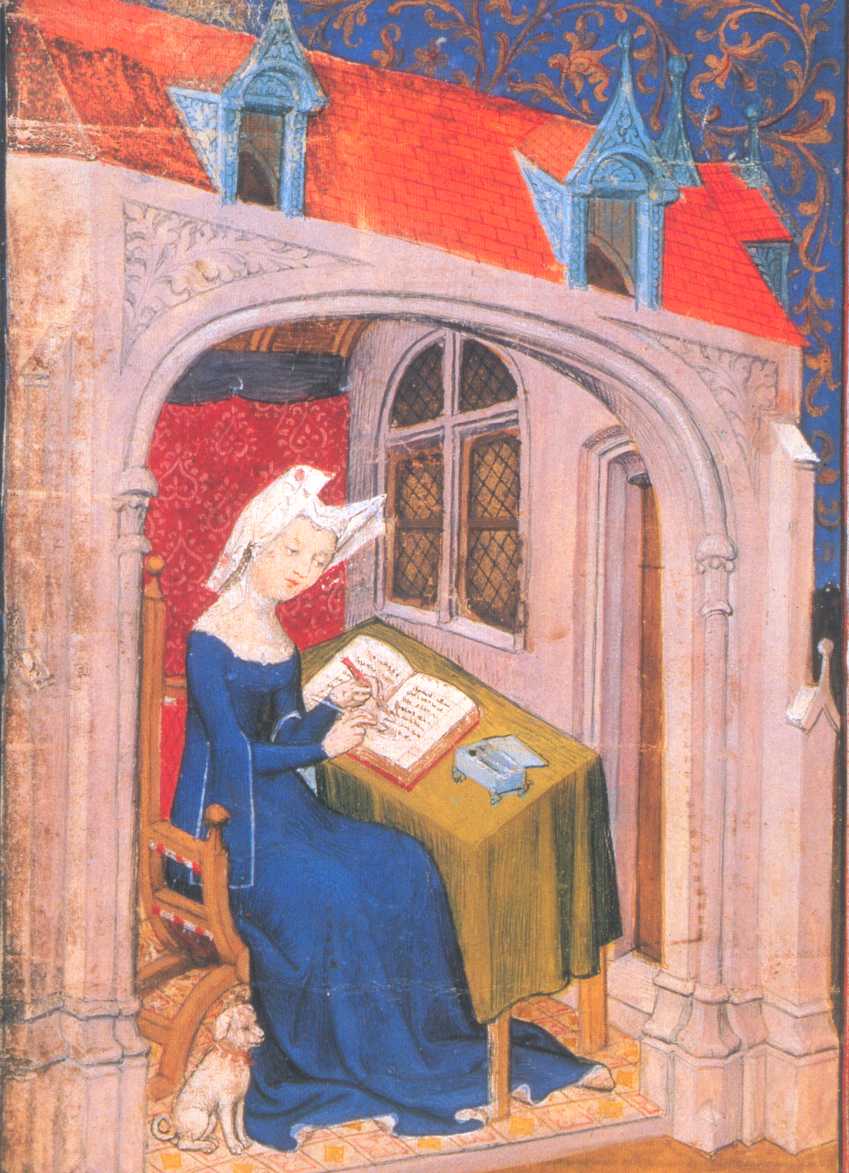
The most famous image of Christine de Pizan was painted while she was alive, and it shows her alone. She sits in an arched alcove with a red tapestry behind her, a diamond-paned window to her right, a small white dog at her feet, and a manuscript open on a desk covered with a green cloth. Her right hand holds the quill. The book is already half full of lines.
That image is not a decorative frontispiece. It is an argument, produced by a woman who understood exactly what she was doing with it. In 1414, in a France sliding into civil war, she presented a single bound volume containing thirty of her own works and 130 miniatures to the queen. The opening page shows Christine handing the book to Isabeau of Bavaria. The message is unambiguous: I wrote this, I made this, and I am still working.
She had been widowed at twenty-five with three children and no income. Everything in that picture — the study, the books, the manuscript in progress — she built after the life she had been prepared for ended.
Venice to Paris, 1364 to 1368
She was born Cristina da Pizzano in Venice in September 1364, the daughter of Tommaso di Benvenuto da Pizzano, a physician and astrologer who served as a councillor of the Venetian Republic. In 1368 he accepted an appointment to the court of Charles V of France, and the family moved to Paris. Christine was four years old.
Charles V was the king historians call the Wise, and the court her father entered was the most bookish in Europe. Thomas de Pizan, as he became known, was the king's physician and astrologer, which placed the family close enough to power to absorb its habits. Christine grew up in a household where the currency was manuscripts, and in a kingdom where the king himself collected them.
Her father then did something unusual. He insisted that his daughter learn philosophy, Latin, Italian, French, history, literature and science. For a girl in fourteenth-century France that was not merely uncommon; it was a deliberate act against the grain of every institutional structure around her, because the University of Paris did not admit women and would not for centuries. Whatever she learned, she would never be able to convert it into a degree, a teaching post, or a licence to practice anything.
The distinction matters for her later life. The Latin she had as a girl was real but partial — enough to read, not the drilled fluency of a university-trained cleric — and she composed everything she published in French. She spent the rest of her career building on a foundation that stopped early, which is a situation most adult learners will recognize.
Eighteen Months That Ended One Life
In 1379, at fifteen, she married Étienne du Castel, a notary and royal secretary. By the standards of the time it was a good match, and by the evidence of her later writing it was a happy one. She had three children. Her daughter would eventually enter the Dominican convent at Poissy as a companion to the king's daughter Marie.
Then the structure came down in less than two years. Her father died in 1388. In 1389 her husband died of plague. A court record dated 4 June 1389 already refers to her as damoiselle and "widow of Estienne du Castel," which is how a legal identity replaces a person.
She was twenty-five. She had three children, her mother, and a niece to support. Her husband's salary was still owed by the crown, and collecting it meant litigation against parties with better lawyers and better connections. The lawsuits dragged. The money did not arrive on schedule. This is the moment that most biographies treat as the beginning of her career, and it is worth being precise about what it actually was: not a calling, but a household that needed income.
Teaching Herself the Rest
What Christine did next is the part of her life with the clearest lessons for anyone learning anything late. She turned her widowhood into a curriculum.
She read. She read the Latin authors her father had opened for her and the French and Italian ones she could reach on her own, and she read them as a writer rather than as a student — noting how arguments were built, how authorities were cited, how a case was made. She later described, in her own account of her life, years spent in study as consolation and then as preparation. Nobody handed her a syllabus after 1389. The library was her father's inheritance, and the method was hers.
By 1393 she was writing love ballads, and they found patrons at court. Ballads were the commercial form of the moment; a poet who could produce them for a wedding or a season could be paid. She was paid. Over the next three decades she worked for Louis I of Orléans, Philip the Bold of Burgundy, John the Fearless, and Queen Isabeau, and she did it in the hardest possible conditions — through a royal breakdown, an assassination, and a civil war.
That combination of output and commercial survival has earned her the description, used by most historians who write about her, of the first professional woman of letters in Europe. Not the first woman to write. The first to make writing a business.
The Quarrel That Made Her Name
In 1402 she picked a fight that a writer with less nerve would have avoided. The Romance of the Rose was the most admired poem in France, and its second author, Jean de Meun, had filled it with passages that treated women as instruments of seduction. Christine wrote to the most senior men of letters in Paris and said the poem was wrong — not immoral in a vague way, but argued badly, its authorities misused, its conclusions unearned.
The exchange became the Querelle du Roman de la Rose, the first literary quarrel in French, and it made her reputation as a controversialist. She was arguing, in effect, that a text does not become true because it is famous, and that a reader is allowed to check a beloved author's citations. That is a scholar's instinct, and she had assembled it herself.
Building the City
The books came quickly after that. In 1400 she published the Epître Othéa a Hector, a guide to statecraft in which the goddess of wisdom tutors Hector of Troy, and she produced luxury illustrated editions of it, rededicating copies for different patrons, including one for Henry IV of England in 1404.
In 1403 she wrote Le Chemin de long estude, a dream allegory in which she travels with the Cumaean Sibyl and watches four allegories — Wealth, Nobility, Chivalry and Wisdom — debate the state of the world. In 1404 came the biography Charles V commissioned from her: Le Livre des fais et bonnes meurs du sage roy Charles V. It was commissioned by Philip the Bold, and when Philip died before it was finished she offered it to Jean, Duke of Berry, then was paid 100 livres for it in 1406 by Philip's successor.
One detail inside that book is a small door into her whole argument. Praising Charles V's Latin, she broke off to lament that her contemporaries had to resort to strangers to read the law to them — that the language of authority had become a wall most French readers could not climb. She was not romantic about Latin. She had watched what happens to people who do not have it.
Then, in 1405, two books in one year. Le Livre de la cité des dames — The Book of the City of Ladies — builds an allegorical city from the stories of women who had been rulers, scholars, inventors and generals, with Reason, Rectitude and Justice as the masons. Le Livre des trois vertus, known in English as The Treasure of the City of Ladies, was dedicated to the dauphine Margaret of Nevers and told a young princess what she needed to learn.
Inside the first of those books is the sentence that has outlived everything else she wrote:
"If it were customary to send little girls to school and to teach them the same subjects as are taught boys, they would learn just as fully and would understand the subtleties of all arts and sciences."
It is a claim about method disguised as a claim about justice. She is not saying women are secretly brilliant. She is saying the observed difference between what men and women know is an artifact of who gets sent to school, and that the experiment has never been run.
Writing in French on Purpose
Her most revealing publication decision came in 1410. She wrote Le Livre des fais d'armes et de chevalerie, a manual of military practice drawing on Vegetius, Frontinus and Valerius Maximus, and she explained in the preface why she had written it in French rather than Latin: so that it could be read by practitioners of war not well versed in Latin.
That is a translation decision made by someone who understood exactly what a language barrier costs. A manual that only the clergy can read does not help the men fighting. In early 1411 the royal treasury paid her 200 livres for it.
The same logic shows up in Livre de la paix in 1413, her last major work, addressed to the young dauphin in the middle of a civil war. She quoted scripture at him about a kingdom divided against itself, argued that peace and justice were possible on earth, and told him to take advice from people older or wiser than himself. The book was written in the vernacular because the argument had to reach the person making the decisions.
The Book She Made With Her Own Hands
In 1414 the queen asked her for a collection of her works, and Christine produced what is now known as The Book of the Queen — thirty of her writings in one volume, with 130 miniatures. She supervised the production, worked with the best illuminators in Paris, and had herself painted into the frontispiece presenting the finished book.
This is the part of her method that modern learners tend to skip. She did not write a text and hand it off. She ran the whole pipeline: drafting, revising, commissioning images, checking the copy, choosing the page. Producing her own books was how she kept learning — every rededication for a new patron meant rereading her own argument against a different reader's needs.
Production as study is not a medieval curiosity. It is the same mechanism behind the finding that learners who prepare material to teach it, or who build something out of what they have read, retain more than learners who review it again. Christine built the thing, and building it kept her inside her own material for thirty years.
Joan, and the End
By 1418 Paris was occupied and France was in pieces, and Christine withdrew to the Dominican convent at Poissy, where she is generally thought to have spent her last decade. Her literary activity largely stopped.
Then, in 1429, a teenage girl lifted the siege of Orléans. Within days of Charles VII's coronation, Christine broke a decade of silence and wrote Dití de Jehanne d'Arc — a poem hailing Joan as the fulfillment of prophecies by Merlin, the Cumaean Sibyl and Bede. It is the only work celebrating Joan written during Joan's lifetime by a known author, and it was written by a woman of about sixty-five who had spent her career arguing that the evidence about what women could do was corrupted by who was allowed to try.
She died around 1430, probably at Poissy, before the English tried and burned the subject of her last poem. She had produced more than forty works across poetry, biography, political theory, military instruction, moral philosophy and devotional writing, and had supported a household on the proceeds.
What She Actually Taught Herself
The honest version of Christine de Pizan's education is more useful than the heroic one. She did not teach herself from nothing. Her father gave her the first keys — the languages, the access to books, the permission to be curious — and that head start is the part most people who admire her never had.
What she did alone was everything after that. She built a curriculum with no teacher, in a city that would not let her into its university, while raising three children and suing her husband's employer for his wages. She chose the language her readers could actually read instead of the one that carried prestige. She read famous authors and checked their citations. She made her own books, end to end, and learned her craft by producing rather than by being taught.
Four things from her life transfer directly to anyone learning a language now, and none of them require her father.
- Use the language your audience actually speaks. She wrote in French because Latin excluded the people who needed the manual. The version of a language that gets used is worth more than the version that gets admired.
- Build your own syllabus when nobody will issue one. Her curriculum after 1389 consisted of books she chose and arguments she picked. That is a study plan, and it worked for thirty years.
- Check the famous text. Her first public act as a writer was telling Paris that its most beloved poem was argued badly. Reading critically is a skill, and it is learnable.
- Produce, do not just consume. She supervised scribes, chose illuminators, corrected copies and rededicated editions. Every one of those acts was a rereading, and rereading with a purpose is what makes material stay.
The Room With the Desk
The image at the top of this page is the one she chose to be remembered by: a woman alone in a room, with a book open and a quill in her hand, a window, a dog, and no one else present.
She had been widowed at twenty-five, had watched both the men who could have opened doors for her die within eighteen months of each other, and had spent the next four decades making a living from sentences in a country that was falling apart around her. The room in the picture is not a refuge from that. It is the machine she built to survive it.
Her argument about the schoolroom is still unanswered, which is the uncomfortable part. She claimed that if girls were taught the same subjects as boys, they would learn just as fully. Six hundred years later the claim is testable in most of the world and still unevenly tested, and the learners who fall outside whatever the local version of the schoolroom is — too old, too poor, too late, the wrong passport, the wrong language at home — are still doing what she did. Finding the books. Inventing the method. Checking the famous author's citations.
She left a sentence for them, and it doubles as a study plan: the difference between people who know things and people who do not is mostly a difference in who was allowed to try.