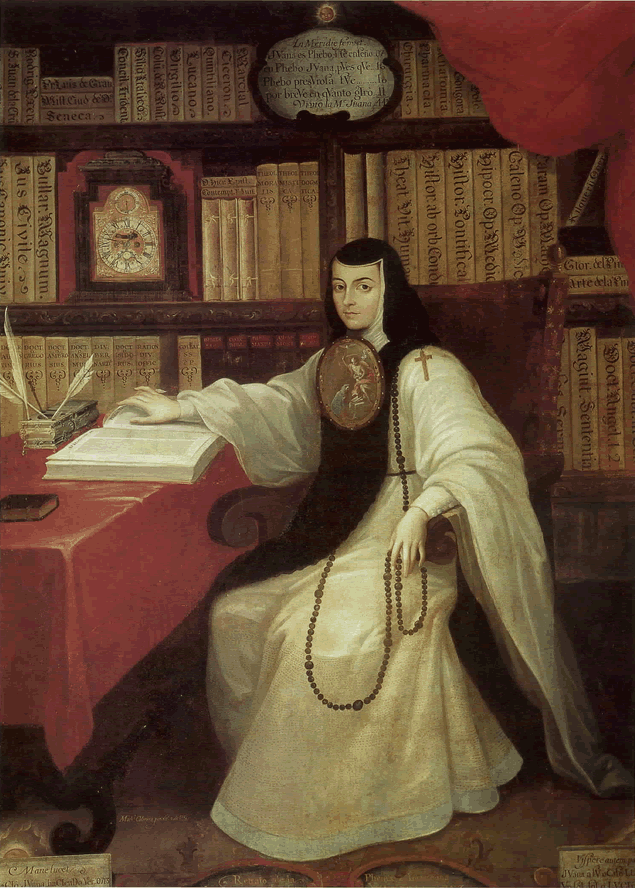
In the year 1664, a 16-year-old girl named Juana Ramírez de Asbaje arrived at the viceregal court of New Spain — modern-day Mexico. She was beautiful, brilliant, and desperate for an education that the world had decided she did not deserve. Because she was born an illegitimate child, because she was a woman, and because the 17th century believed that women had no need for learning beyond household management, all the universities of the Spanish Empire were closed to her. She had already taught herself to read at age three, mastered Latin logic by adolescence, and begun writing poetry that would one day be celebrated across two continents. But the formal education she craved was forbidden.
So Juana did something extraordinary. She made a choice that would define the rest of her life: she entered a convent. Not because she felt a religious calling — though she was sincerely devout — but because the convent was the only place in 17th-century Mexico where a woman could pursue knowledge freely. As she later wrote, she chose the religious life because she wanted "to have no fixed occupation which might curtail my freedom to study."
Thus began the intellectual career of Sor Juana Inés de la Cruz — the Tenth Muse, the Mexican Phoenix, one of the greatest writers of the Spanish Golden Age, and perhaps the most remarkable self-taught intellectual of the early modern world. Her story is not just a story of female genius triumphing over oppression. It is a testament to the raw, unquenchable hunger for learning that some people possess — a hunger that no law, no custom, and no authority can extinguish.
Early Life: The Prodigy Who Hid in Her Grandfather's Library
Juana Inés de Asbaje y Ramírez de Santillana was born on November 12, 1648 (or possibly 1651 — the records are disputed) in San Miguel Nepantla, a small village about 80 kilometres southeast of Mexico City. She was the illegitimate daughter of Don Pedro Manuel de Asuaje y Vargas-Machuca, a Spanish navy captain from the Canary Islands, and Doña Isabel Ramírez de Santillana, a creole woman from a wealthy local family. Her father abandoned the family when Juana was very young, leaving her mother to raise three children out of wedlock — a social stigma that would follow Juana throughout her life.
The family lived on the hacienda of Panoayan, leased by Juana's maternal grandfather, a prosperous landowner. And there, in her grandfather's house, Juana discovered the most important place in her world: the library. Her grandfather had amassed an impressive collection of books — rare and valuable in a colonial outpost where printed materials were expensive and hard to come by. For the young Juana, this library was everything.
By the age of three, she had taught herself to read Latin and Spanish. She later described this period of her life with characteristic precision: she would hide in the hacienda chapel to read her grandfather's books, knowing that her activities would have been forbidden if discovered. Girls were not supposed to read. They were certainly not supposed to read theology, philosophy, and natural science. But Juana could not stop herself. The books called to her with an irresistible force.
I used to go to the chapel and without anyone knowing, I would take the books and read. I felt such a strong inclination toward letters that neither scoldings nor punishments could stop me. — Sor Juana, from her autobiographical writing
Child Prodigy, Denied Formal Education
By age five, Juana could do accounts and had memorised the Catholic liturgies in Latin. At age six, she begged her mother to let her disguise herself as a boy so she could attend the university in Mexico City. Her mother refused. The paths of formal education were closed to her forever.
But Juana did not stop learning. At age eight, she composed her first known poem — a devotional work on the Eucharist. By age thirteen, she had mastered Greek logic and was teaching Latin to younger children. She also learned Nahuatl, the language of the Aztecs, though recent scholarship has debated the extent of her fluency. What is clear is that she was surrounded by a multilingual world — Spanish, Latin, Nahuatl — and she absorbed languages the way a sponge absorbs water.
In 1664, at age 16, Juana was sent to live in Mexico City, the capital of the Viceroyalty of New Spain. Her family's social connections secured her a position as a lady-in-waiting at the viceregal court of the Marquis de Mancera, Don Antonio Sebastián de Toledo. The court was the centre of intellectual and cultural life in the colony, and Juana thrived in it. She wrote poetry, engaged in philosophical discussions, and quickly became a favourite of the Vicereine, Doña Leonor del Carretto.
The Trial of the Theologians
Juana's reputation for learning grew so rapidly that the viceroy himself decided to test her. He convened a panel of forty theologians, jurists, philosophers, and poets — the brightest minds in New Spain — and brought the 17-year-old Juana before them. For hours, they questioned her on every subject imaginable: theology, astronomy, history, mathematics, poetry, law, natural philosophy, music, and the sciences. They asked difficult questions, pressed her on obscure points, and tried to find gaps in her knowledge.
She answered every question. She defended every argument. She astonished every scholar in the room. The viceroy later wrote that she performed "like a royal galleon defending itself against small boats." The event became legendary in Mexico City. Juana had proven that a self-taught girl could match the greatest scholars of the colony — and surpass them.
Choosing the Convent: Freedom Through Enclosure
Despite her triumph, Juana faced an impossible choice. The court offered her marriage proposals from wealthy and powerful men. But marriage would mean children, household management, and the end of her intellectual life. The university was closed to women. There was no profession open to a female scholar. The only path that allowed women to study and write was the religious life.
In 1667, Juana entered the Monastery of St. Joseph, a community of Discalced Carmelite nuns. The Carmelite rule proved too strict for her — the order required severe physical mortification and limited study time. She left after a few months. In 1669, she entered the Convent of Santa Paula of the Hieronymite nuns, a more relaxed order that permitted intellectual work. She would remain there for the rest of her life, taking the name Sor Juana Inés de la Cruz.
The convent was not a prison for Sor Juana. It was a sanctuary for her mind. Her cell became a salon — a gathering place for the intellectual elite of New Spain. Scholars, poets, nobles, and vicereines visited her regularly. She filled her quarters with books, scientific instruments, and musical devices. She amassed a personal library of over 4,000 volumes — one of the largest in the Western Hemisphere — along with a collection of musical instruments and scientific apparatus. She studied astronomy, physics, mathematics, theology, philosophy, and the classical authors. She wrote poetry, plays, and religious works that would make her the most important literary figure of the Spanish Baroque.
I became a nun because, although I knew that the religious state had many things that were repugnant to my nature, nevertheless, given my total disinclination toward marriage, it was the least unreasonable and most becoming state I could choose to assure my salvation. — Sor Juana
The Library and Intellectual World
Sor Juana's library was legendary. In an era when most women in New Spain could not read, and when the few literate women rarely owned more than a prayer book and a devotional manual, Sor Juana possessed thousands of volumes covering every branch of knowledge. She had the complete works of Aristotle, Plato, Seneca, Ovid, and Virgil. She owned the Church Fathers — Augustine, Jerome, Thomas Aquinas. She had contemporary works of natural philosophy, including the writings of Descartes, Galileo, and Kepler. She had mathematics treatises, books on astronomy, music theory, and natural history.
She read everything. And she argued with everything. One of her most celebrated intellectual achievements was a critique of a famous sermon by the Portuguese Jesuit António Vieira — one of the most respected preachers in the Catholic world. Sor Juana disagreed with Vieira's interpretation of a passage about Christ's greatest act of love, and she said so, in writing, with meticulous theological reasoning. The critique circulated in manuscript form and created a sensation.
Intellectual Defiance: The Letter That Changed Women's Education
In November 1690, the Bishop of Puebla, Manuel Fernández de Santa Cruz, published Sor Juana's critique of Vieira's sermon under the title Carta Atenagórica ("Letter Worthy of Athena") — without her permission. Alongside it, he published his own letter under the pseudonym "Sor Filotea de la Cruz," in which he praised her intellect but admonished her to focus on religious rather than secular studies. His message, wrapped in flattery, was clear: women should not engage in theological and philosophical disputation.
Sor Juana's response is one of the most important documents in the history of women's education. In March 1691, she wrote the Respuesta a Sor Filotea de la Cruz ("Reply to Sister Philotea") — a brilliant, 50-page defence of women's right to education, learning, and intellectual authority.
The Respuesta is a masterpiece of rhetoric and scholarship. Sor Juana begins by humbly apologizing for writing the critique of Vieira, then systematically dismantles every argument against women's education. She cites Scripture, the Church Fathers, classical authors, and the lives of learned women throughout history — from the prophetess Deborah in the Old Testament to the Christian martyr Saint Catherine of Alexandria. She points out that many of the Church's most revered female saints were scholars, writers, and teachers.
One can perfectly well philosophize over dinner. — Sor Juana Inés de la Cruz, from the Respuesta
She argues that women not only have the right to learn but also the right to teach. She proposes that older women should be authorized to educate younger women — a radical proposal in a society where women were forbidden from teaching anything beyond basic domestic skills. She also defends her own intellectual pursuits, writing that she studied "not to shine or to be praised, but to know. Knowledge for its own sake."
The Respuesta a Sor Filotea is now considered one of the earliest and most powerful feminist manifestos in the Western tradition. It predates Mary Wollstonecraft's A Vindication of the Rights of Woman by exactly one hundred years. Sor Juana was writing in defence of women's intellectual freedom in an era when women in Spanish colonies could be punished — even executed — for reading the wrong books.
The Cost of Defiance
Sor Juana's boldness came at a terrible price. Powerful figures in the Church hierarchy were offended by her challenge to clerical authority. Her critique of Vieira and her defence of women's learning had made powerful enemies. In 1694, under pressure from her confessor, Sor Juana was forced to renounce her intellectual pursuits. She signed a document in her own blood, reaffirming her faith and promising to give up her books and studies.
She sold her entire library — 4,000 volumes, the accumulation of a lifetime of learning. She donated the proceeds to charity. She sold her scientific instruments and her musical devices. She devoted the remaining months of her life to acts of penance and service to the poor. On April 17, 1695, while tending to her fellow nuns during a plague epidemic, Sor Juana contracted the disease and died. She was 47 years old.
Literary Legacy: The Tenth Muse of the Spanish Golden Age
Sor Juana's literary output was extraordinary in both quantity and quality. She wrote poetry in every major form of the Spanish Baroque: sonnets, romances, redondillas, décimas, and villancicos. Her most famous poem, "Hombres necios que acusáis" ("Foolish Men Who Accuse"), is a devastating critique of the double standards applied to women:
Hombres necios que acusáis
a la mujer sin razón,
sin ver que sois la ocasión
de lo mismo que culpáis
(Foolish men, who accuse
women without reason,
without seeing that you are the cause
of the very thing you blame)
This poem, written in the 1680s, remains one of the most widely anthologized works in Spanish literature. Its themes — hypocrisy, the double bind placed on women, the injustice of blaming victims — are as relevant today as they were three centuries ago.
She also wrote plays, including Los empeños de una casa ("The Trials of a House") and the shorter El divino Narciso ("The Divine Narcissus"), an allegorical auto sacramental that is considered one of the finest religious plays of the Spanish Golden Age. Her prose works include the Respuesta and a series of philosophical and theological treatises.
Sor Juana's work was published in Spain during her lifetime — a rare honour for a colonial writer, and almost unheard of for a woman. She was called "the Tenth Muse" and "the Mexican Phoenix" by her admirers in Spain and New Spain alike. After her death, her collected works went through multiple editions in Spain, establishing her as one of the canonical voices of Spanish literature.
Why Sor Juana Matters for Modern Learners
Sor Juana Inés de la Cruz was not a polyglot in the conventional sense — though she read and wrote in Latin, Spanish, and likely Nahuatl, and knew Greek well enough to read the New Testament and classical philosophy in the original. But her story holds profound lessons for anyone engaged in self-directed learning today.
Lesson 1: The Desire to Learn Cannot Be Forced, But It Cannot Be Stopped Either
Sor Juana's hunger for knowledge was not the result of external motivation, grades, or parental pressure. It was intrinsic. She read because she could not not read. This is the deepest and most sustainable form of motivation — the kind that persists through punishment, social ostracism, and even the threat of death. Modern language learners can cultivate this by connecting their studies to genuine interests rather than external obligations. Sor Juana did not study to impress anyone. She studied because understanding the world was the most natural and necessary activity she could imagine.
Lesson 2: A Library Is the University of the Self-Taught
Sor Juana had no teacher, no institution, no degree programme. She had her grandfather's library and later her own collection. Everything she learned came from books. This is a powerful reminder that the resources for a complete education already exist. In the 21st century, with the internet, open-access journals, and free educational platforms, the barriers to knowledge are lower than they have ever been. The only thing standing between you and fluency in a foreign language is the amount of comprehensible input you consume — and you have access to more of it than Sor Juana could have dreamed of.
Lesson 3: The Only Valid Purpose of Knowledge Is Knowledge Itself
Sor Juana's motto could have been "knowledge for its own sake." She did not study to get a job, to pass a test, or to earn social status. She studied because understanding the world was a sacred act. This orientation — intrinsic motivation driven by curiosity — is the most powerful predictor of long-term success in any difficult learning endeavour, including language acquisition. Learners who study a language because they genuinely want to understand a culture, read literature in the original, or communicate with people they care about consistently outperform learners who are driven by external pressures.
Lesson 4: Constraints Can Fuel Creativity
Sor Juana faced constraints that would have crushed a lesser spirit. She was illegitimate, female, and colonial — three strikes that should have condemned her to obscurity. But the constraints became the material of her art. Her writing about women's condition, her defence of intellectual freedom, her negotiation of the line between obedience and defiance — all of it was shaped by the obstacles she faced. For language learners, the lesson is that constraints (limited time, imperfect resources, challenging circumstances) do not have to be barriers. They can be parameters within which creativity and determination find expression.
Recovery and Recognition: The Rediscovery of Sor Juana
For centuries after her death, Sor Juana's work was read but her significance was underestimated. She was treated as a curiosity — a brilliant woman in an age that did not know what to do with brilliant women. In the 20th century, that changed dramatically. Feminist scholars rediscovered Sor Juana as a foundational figure in the history of women's intellectual life. The Mexican Revolution of 1910 elevated her as a symbol of Mexican national identity. Her face appeared on Mexican currency. Her image was painted by Diego Rivera and Frida Kahlo. Schools were named after her.
In 1974, the Mexican government issued a stamp in her honour. In 1995, UNESCO declared her work part of the Memory of the World Register. In 2016, a three-volume critical edition of her complete works was published by the University of Pau in France. In 2019, the Google Doodle celebrated her birthday. In 2020, the city of Mexico held a series of events marking the 325th anniversary of her death. Her poems are memorized by schoolchildren across Latin America.
But the most important recognition happened in a different arena. Sor Juana's Respuesta a Sor Filotea is now taught in universities around the world as a foundational text of feminist philosophy and women's intellectual history. It is studied alongside the work of Christine de Pizan, Mary Wollstonecraft, and Virginia Woolf. Her insistence that women have a right — a duty, even — to pursue knowledge has influenced generations of women in Latin America and beyond.
Conclusion: The Phoenix Still Burns
Sor Juana Inés de la Cruz died in 1695, her library sold, her instruments gone, her voice supposedly silenced. But her words survived. The poems, the plays, the letters, the philosophical arguments — they outlasted the Inquisition, the colonial system, and the patriarchal structures that tried to contain them. Today, she is read, studied, and celebrated more widely than at any point in her life.
Her story is a reminder that the desire to learn is the most indestructible human impulse. You can cage the body. You can restrict the social opportunities. You can even take away the books. But the mind — once awakened — cannot be put back to sleep. Sor Juana understood this better than anyone. She chose a life that allowed her to think, to study, and to write. And in doing so, she built a legacy that has outlasted empires.
For the language learner reading this today: you face no inquisitors. No one is telling you that the pursuit of a second language is forbidden. Your barriers are not walls — they are the ordinary difficulties of time, effort, and discomfort. Sor Juana faced a society that literally forbade women from learning. She persisted anyway. If she could build one of the great intellectual careers of the 17th century with her grandfather's books and a convent cell, you can learn a language with the internet, a flashcard app, and the same quality she possessed above all others: unwavering determination.
FluentCards is built for self-taught learners in the tradition of Sor Juana. No gatekeepers, no prerequisites, no permission required — just you and the language you want to learn. Start your journey at fluentcards.org/app.