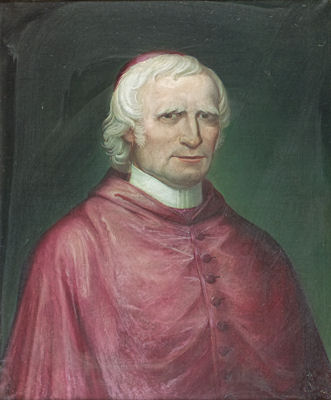
In the early 19th century, a priest from Bologna became the centre of one of the most remarkable debates in the history of linguistics. The question was simple: could one person truly master seventy-two languages? And if so, what kind of mind could hold that much linguistic information?
The man at the centre of this debate was Giuseppe Gasparo Mezzofanti (1774–1849), a Catholic cardinal whose linguistic abilities were legendary even during his own lifetime. Travellers from across Europe made pilgrimages to Rome specifically to test him. Diplomats brought obscure dialects from distant colonies, trying to find a language he did not know. Rival polyglots wrote books accusing his admirers of exaggeration. And through it all, Mezzofanti himself remained remarkably humble, describing himself as nothing more than “an ill-bound dictionary.”
Whether the true number of languages he knew was 38, 50, 60, or 72, one thing is certain: Giuseppe Mezzofanti stands as one of the most extraordinary hyperpolyglots in human history. His story offers a fascinating window into the nature of linguistic giftedness, the limits of human memory, and the cultural politics of language learning in 19th-century Europe.
The Boy from Bologna: Early Signs of a Gift
Giuseppe Mezzofanti was born on 19 September 1774 in Bologna, then part of the Papal States in what is now northern Italy. His father, Francesco Mezzofanti, was a carpenter. His mother, Gesualda Dall’Olmo, was a homemaker. There was nothing in his family background to suggest that this child of modest means would become one of the most celebrated linguists in European history.
But from his earliest years, young Giuseppe displayed abilities that set him apart. His biographer, the Catholic clergyman Charles William Russell, who wrote the definitive 1858 biography The Life of Cardinal Mezzofanti, recorded that the boy had an extraordinary musical ear, a prodigious memory, and a seemingly insatiable curiosity about languages. He studied with the Piarist fathers in Bologna, a Catholic religious order known for its emphasis on education.
The Piarist school in Bologna attracted missionaries from around the world. These men had served in Sweden, Germany, Spain, and the Spanish colonies in South America. Young Mezzofanti would seek them out after class, listen to them speak, and ask them to teach him words and phrases in their languages. By the time he was a teenager, he had already acquired a working knowledge of Swedish, German, Spanish, and several indigenous languages of South America — all in addition to the Latin and Ancient Greek he was studying formally.
What am I but an ill-bound dictionary? — Giuseppe Mezzofanti, when asked about his linguistic abilities
His teachers were astonished by the speed of his learning. According to Russell, Mezzofanti could master a language’s entire grammar in a matter of days and begin speaking it with reasonable fluency within weeks. But unlike many gifted learners who rely on rote memorization, Mezzofanti seemed to have a genuine feel for the internal structure of languages. He did not just memorize words. He understood how the grammar worked at a deep, intuitive level.
The Young Priest and the Political Storm
Mezzofanti completed his theological studies before he had reached the minimum age for ordination as a priest. He was finally ordained in 1797 at the age of 23. The same year, he was appointed professor of Arabic, Hebrew, Oriental languages, and Greek at the University of Bologna — an extraordinary appointment for a man so young, and one that reflected the university’s recognition of his exceptional linguistic gifts.
But 1797 was not a good year to begin an academic career in northern Italy. The French Revolution had sent shockwaves across Europe. Napoleon Bonaparte was sweeping through Italy, and the Cisalpine Republic — a French puppet state — had been established in Bologna. The new republican government demanded that all professors take an oath of allegiance. Mezzofanti refused.
The oath required him to swear loyalty to a government that was, in his view, an illegitimate usurper of both papal and traditional civic authority. His refusal cost him his professorship. He was stripped of his position and his income, left with nothing but his linguistic skills and his faith.
It was during this period of political turmoil that Mezzofanti found an unexpected classroom. Between 1799 and 1800, Bologna became a hospital for soldiers wounded in the Napoleonic Wars. Soldiers from across Europe — French, German, Austrian, Spanish, Swiss, Croatian, Hungarian — were treated in the city. Mezzofanti visited them regularly, not just to offer spiritual comfort but also to learn their languages. He would sit by their bedsides, listening to them speak, asking about their homes and families, and absorbing the sounds and structures of their native tongues.
This was not casual language sampling. According to Russell, Mezzofanti systematically practiced each language every day, maintaining his existing skills even as he acquired new ones. By the end of the Napoleonic period, he had added several more European languages to his repertoire.
The Return to Academia and the Vatican Years
In 1803, the political situation stabilized enough for Mezzofanti to return to academic life. He was appointed assistant librarian of the Institute of Bologna and was soon reinstated as professor of Oriental languages and Ancient Greek. The chair of Oriental languages was briefly suppressed again in 1808 by the viceroy Eugène de Beauharnais, but it was restored in 1814 when Pope Pius VII returned to power. Mezzofanti held this post for nearly two more decades.
His reputation as a linguistic prodigy grew steadily during these years. Visitors to Bologna made a point of seeking him out. The poet Lord Byron, who lived in Italy during this period, was one of the many who tested Mezzofanti. Byron spoke fluent Italian and French, as well as some Greek, Turkish, and Armenian. He later wrote that Mezzofanti had “a most extraordinary memory” and that he could converse in languages Byron had never even heard of. The poet was particularly struck by Mezzofanti’s ability to switch between languages in mid-sentence, matching any language thrown at him.
In 1831, Mezzofanti was called to Rome to join the Congregation for the Evangelization of Peoples (Congregatio de Propaganda Fide), the Catholic Church’s governing body for missionary activities. This was a natural fit for a man of his linguistic talents. The Propaganda Fide was responsible for Catholic missions around the world, and its members regularly dealt with documents and correspondents in dozens of languages. Mezzofanti quickly became indispensable.
In 1833, he succeeded Angelo Mai as Custodian-in-Chief of the Vatican Library, one of the most prestigious scholarly positions in the Catholic world. And in 1838, he was elevated to the College of Cardinals by Pope Gregory XVI, receiving the titular church of Sant’Onofrio. As cardinal, he also served as director of studies for the Propaganda Fide, overseeing the education of missionaries who would be sent to every corner of the globe.
The Legend of 72 Languages: How Many Did He Really Know?
The most famous claim about Mezzofanti is that he knew seventy-two languages. This precise number has biblical resonance — it is the same number that appears in the story of the Tower of Babel, where humanity’s single language was supposedly divided into seventy-two tongues. Some scholars have suggested that the number was chosen for its religious symbolism rather than its accuracy.
The actual evidence is more complex. Let us examine the different sources of information:
Russell’s Catalogue
Charles Russell, in his 1858 biography, provided a detailed catalogue of Mezzofanti’s languages organized into four categories of proficiency:
- Category 1 — Nine languages that were “frequently tested, and spoken with rare excellence”: Latin, Italian, Spanish, Portuguese, French, German, English, Ancient Greek, and Modern Greek.
- Category 2 — Nine languages that were “spoken fluently, but hardly sufficiently tested”: Dutch, Flemish, Swedish, Danish, Russian, Polish, Czech, Hungarian, and Turkish.
- Category 3 — Eleven languages “spoken rarely, and less perfectly”: These included Arabic, Hebrew, Persian, Armenian, and various other Middle Eastern and Asian languages.
- Category 4 — Twenty-two languages “spoken imperfectly or studied from books”: This category included languages as diverse as Chinese, Sanskrit, Malay, Japanese, and multiple indigenous American languages.
This produces Russell’s total of seventy-two languages. But his contemporary, the British polyglot Thomas Watts, criticized this figure as an exaggeration. Watts, who was the keeper of the British Museum’s printed books and a polyglot himself, argued that the true number of languages Mezzofanti could actually speak fluently was closer to 30 or 31. Russell later conceded this point, agreeing that if one excluded languages in which the cardinal had only a very basic knowledge, the number was indeed closer to 60.
The Archival Evidence
Modern scholarship has examined Mezzofanti’s surviving papers, which are held in the Biblioteca comunale dell’Archiginnasio in Bologna. These documents include word lists, parallel texts, and linguistic descriptions in at least 56 languages, some written in Mezzofanti’s own hand and others collected by him for learning purposes. This suggests that he had at least some knowledge of 56 languages, though the degree of proficiency cannot be determined from the archival record alone.
I have met with many extraordinary linguists in my time, but never with one who approached Mezzofanti. He was a phenomenon, and it is useless to try to explain him. — An anonymous contemporary quoted by Cardinal Wiseman
A Balanced Assessment
The most reasonable assessment, based on all available evidence, is that Mezzofanti had genuine fluency in about 30 languages, good working knowledge of another 15 to 20, and basic familiarity with perhaps 10 to 15 more. This is still an extraordinary achievement by any standard. Even the most skeptical modern estimates place him among the top handful of hyperpolyglots in recorded history.
What is often overlooked is that Mezzofanti’s knowledge was not limited to vocabulary lists and grammar tables. He could conduct conversations, hear confessions, preach sermons, and write letters in multiple languages. Missionaries preparing for assignments in distant lands would visit him, and he would converse with them for hours in their target languages, correcting their pronunciation and explaining cultural nuances.
How Did He Do It? Mezzofanti’s Methods
Mezzofanti left behind no systematic explanation of his learning methods. But from the accounts of his contemporaries, we can reconstruct the techniques that made him so effective.
Method 1: Conversational Immersion
Mezzofanti learned languages primarily through conversation, not textbooks. When he wanted to learn a language, he would find a native speaker and start talking to them. His early education from missionaries, his hospital visits during the Napoleonic Wars, and his later interactions with diplomats and students all followed this pattern. He learned by listening, repeating, and engaging in real communication.
Method 2: Phonological Precision
Mezzofanti had a remarkable ear for sound. He could reproduce the exact pronunciation of a language after only a few exposures, including tones, clicks, and other sounds that most adult learners struggle with. This made his accent nearly indistinguishable from a native speaker’s — an unusually rare skill among polyglots of his era, most of whom focused on reading and writing.
Method 3: Systematic Maintenance
Perhaps Mezzofanti’s most important technique was his systematic maintenance routine. He did not learn a language and then abandon it. He practiced every language he knew on a regular schedule, often by reading a passage from the Bible aloud in that language, translating it into another language, and then comparing the translations. This maintenance routine kept his languages active and prevented the decay that normally occurs when a language is not used.
Method 4: Parallel Reading
Mezzofanti was a great believer in parallel reading — reading the same text in multiple languages simultaneously. He used the Bible as his primary tool because it was available in dozens of languages. He would read a verse in Latin, then in Greek, then in Hebrew, then in Arabic, then in Syriac, and so on. This method built strong cross-linguistic connections in his mind, allowing him to retrieve words and structures from one language through the framework of another.
Method 5: The Polyglot’s Schedule
According to Russell, Mezzofanti followed a strict daily schedule for language practice. He reserved specific hours for specific languages, rotating through his entire repertoire over the course of a week. He would also take advantage of every opportunity to speak with native speakers, maintaining a mental roster of which languages he had practiced recently and which needed attention.
Mezzofanti’s Legacy: What Modern Learners Can Learn from the Cardinal
Giuseppe Mezzofanti’s story is more than a historical curiosity. His methods and his attitude toward language learning offer valuable lessons for modern learners.
Lesson 1: Conversation Is the Fastest Path to Fluency
Mezzofanti did not spend years studying grammar before attempting to speak. He started speaking from day one, making mistakes and learning from them. This aligns perfectly with modern second-language acquisition research, which emphasizes the importance of comprehensible output — the idea that producing language is as important as understanding it. If you are not speaking your target language, you are missing the most powerful learning tool available.
Lesson 2: Maintenance Is as Important as Acquisition
Mezzofanti understood something that many modern learners ignore: languages fade if you do not use them. His systematic maintenance routine ensured that his hard-won knowledge did not decay. In the modern era, tools like FluentCards with their FSRS spaced repetition algorithm provide a more efficient version of the same principle: reviewing information at optimal intervals to prevent forgetting and strengthen long-term retention.
Lesson 3: Ear Training Is Essential
Mezzofanti’s extraordinary phonological precision was not a supernatural gift. It was the result of focused attention on the sounds of each language. He trained his ear deliberately, paying close attention to the phonetic details that most learners overlook. Modern learners can use TTS (text-to-speech) tools, shadowing techniques, and phonetic training apps to achieve similar results.
Lesson 4: Humility Is a Virtue
Despite his extraordinary abilities, Mezzofanti remained deeply humble about his linguistic gifts. He described himself as an “ill-bound dictionary,” acknowledging that his knowledge was far from complete. This humility served him well: it kept him open to learning, prevented the arrogance that can block progress, and made him a gracious and effective teacher. Modern learners would do well to adopt a similar attitude. The moment you think you have mastered a language is the moment you stop improving.
Lesson 5: Language Learning Is a Lifelong Practice
Mezzofanti never stopped learning. Even in his seventies, when he was a cardinal and one of the most celebrated linguists in the world, he continued to add new languages to his repertoire and to deepen his knowledge of languages he already knew. Language learning for him was not a goal to be achieved and completed. It was a lifelong practice — a habit of mind that enriched every day of his existence.
The study of languages is not a task to be completed but a garden to be tended. Every day you water it, every day it grows. — Adapted from Mezzofanti’s teaching
Conclusion: The Enduring Mystery of the Polyglot Mind
Giuseppe Mezzofanti died in Rome on 15 March 1849 at the age of 74. His reputation as the greatest hyperpolyglot of his age was secure. But the debate over the exact extent of his linguistic abilities continues to this day, more than 170 years after his death.
What makes Mezzofanti’s story so compelling is not the precise number of languages he knew. It is what his life reveals about the human capacity for learning. Mezzofanti was not born with a supernatural gift. He was born with an unusual aptitude for language, yes — but he also worked extraordinarily hard, practiced systematically, and maintained a lifelong discipline that most of us cannot imagine sustaining for even a year.
In an era without recorded audio, without language apps, without online dictionaries, without native speakers at our fingertips, Mezzofanti built a linguistic repertoire that rivals the best modern polyglots. If he could do it with a Bible, a few missionary friends, and an iron discipline, imagine what you can do with modern tools at your disposal.
The secret is not in the tools. It never was. The secret is in the practice — consistent, daily, lifelong practice. Mezzofanti knew this. Now you do too.
Primary sources: Charles William Russell, “The Life of Cardinal Mezzofanti” (1858); Thomas Watts, “On M. Manavit’s Life of Cardinal Mezzofanti” (1854); Michael Erard, “Babel No More: The Search for the World’s Most Extraordinary Language Learners” (2012).
Turn your own language learning journey into a practice worth maintaining with FluentCards — the free flashcard app with FSRS spaced repetition, TTS pronunciation, and AI mnemonics. Start learning today.